




Last updated: Rules, fees and platform policies change. This guide is reviewed and kept current.
The FBA-versus-FBM debate on Amazon usually starts in the wrong place: with the question “which is more profitable”. That is not the right question, because the answer changes product by product. Having one SKU on FBA and another on FBM in the same account is normal; in most mature accounts it is what actually happens.
There is also a widespread piece of misinformation that distorts the decision, and Amazon’s own documentation refutes it plainly. In Featured Offer (buy box) selection, when all else is equal FBA and FBM are equally likely to be featured; Amazon does not count the fulfilment method as an advantage factor. The same page notes two other things that are not taken into account: customer reviews and star ratings, and the offer’s Prime eligibility (offers with and without the Prime badge are equally likely to be featured when all else is equal).
So “you have to move to FBA to win the buy box” is not true. FBA’s advantage is not privileged treatment in the buy box algorithm but making the things the algorithm does look at easier: a fast and specific delivery date, free shipping, free returns, and performance metrics leaving your responsibility. Seeing that distinction takes the decision out of the emotional register and makes it calculable.
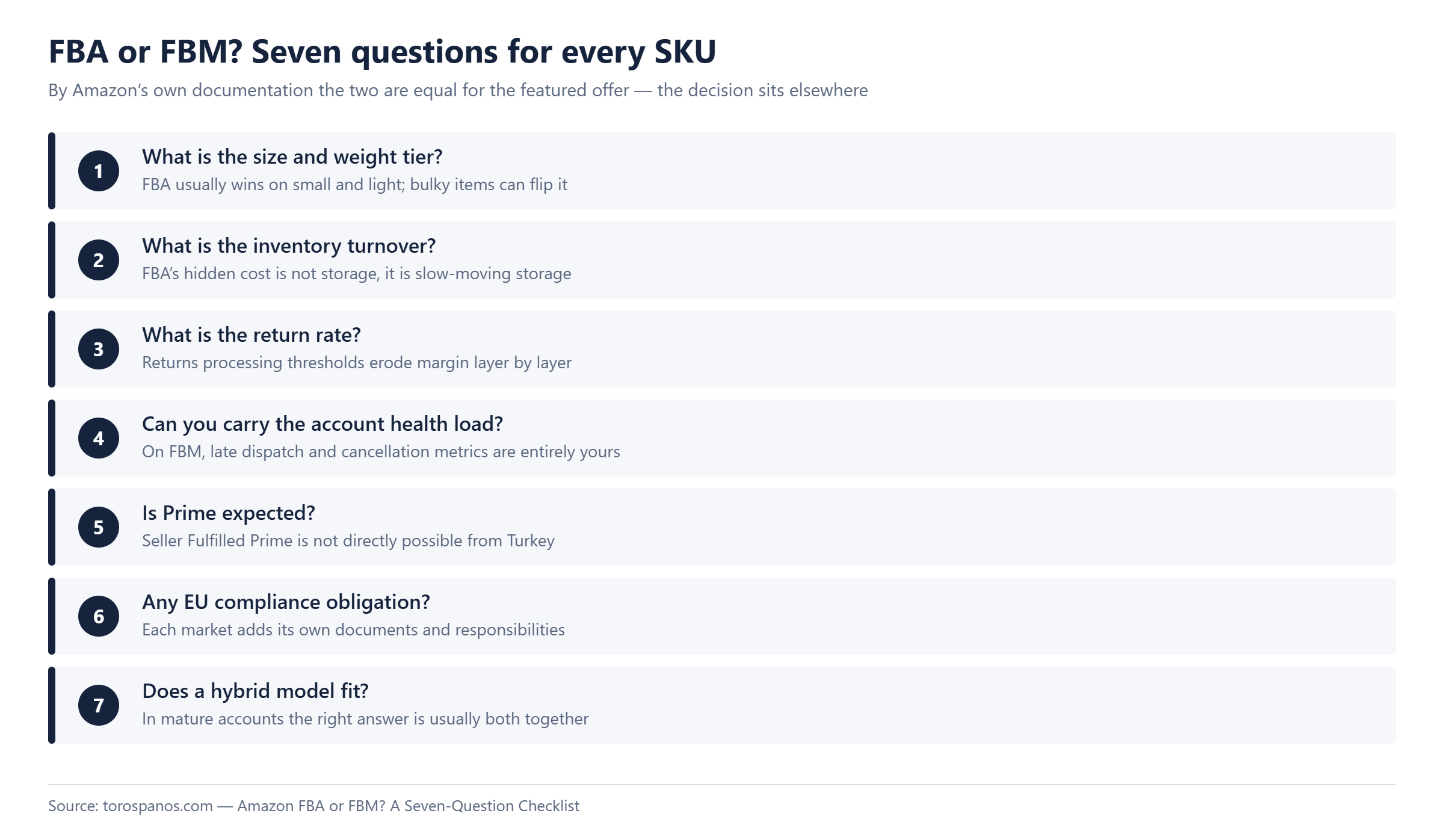
FBA or FBM? Seven questions for every SKU
By Amazon’s own documentation the two are equal for the featured offer — the decision sits elsewhere.
- What is the size and weight tier?FBA usually wins on small and light; bulky items can flip it
- What is the inventory turnover?FBA’s hidden cost is not storage, it is slow-moving storage
- What is the return rate?Returns processing thresholds erode margin layer by layer
- Can you carry the account health load?On FBM, late dispatch and cancellation metrics are entirely yours
- Is Prime expected?Seller Fulfilled Prime is not directly possible from Turkey
- Any EU compliance obligation?Each market adds its own documents and responsibilities
- Does a hybrid model fit?In mature accounts the right answer is usually both together
Definitions, and one technical requirement
With FBA you send the product to Amazon’s warehouses; picking, packing, shipping and customer service are Amazon’s. On the FBM side (merchant fulfilled / seller-fulfilled in Amazon’s official terminology) all of that is yours.
You can sell the same ASIN through both channels together. But rather than moving a single SKU back and forth between channels, you need to create a separate SKU for each fulfilment channel (Manage Inventory → Add another condition). This is the mistake sellers who switch seasonally make most often: managing one SKU by constantly changing its channel muddies both the stock history and the performance data.
FBM’s real cost: account health is on you
The FBM calculation of “I pay the shipping myself, so it is cheaper” is incomplete. The moment you move to FBM, five performance metrics pass directly into your responsibility, and all of them are measured only on seller-fulfilled orders. Amazon’s current published thresholds:
- Order Defect Rate (ODR): under 1%, a 60-day window. Its components: negative feedback (1–2 stars), A-to-z guarantee claims, credit card chargebacks. Exceeding it can suspend your FBM selling privileges.
- Cancellation Rate (CR): under 2.5%, a 7-day window. The critical detail: orders auto-cancelled because shipment was not confirmed within the maximum period also count towards this rate. Customer-initiated cancellations do not.
- Late Shipment Rate (LSR): under 4%, measured over 10-day and 30-day windows together.
- Valid Tracking Rate (VTR): 95% or above, and this metric is measured at product category level. In a category that falls below 95%, your seller-fulfilled listings in that category can be suspended; other categories and FBA listings are unaffected. A valid tracking number requires a first scan from a carrier integrated with Amazon; a number you typed in by hand is not enough.
- On-Time Delivery Rate (OTDR): 90% or above, with Amazon’s own recommendation being above 95%. Since 25 September 2024 the metric is measured before delivery time extensions are applied. This metric does not apply to FBA.
That table shows FBM’s real cost: not money, operational discipline. In a one-person store a holiday, an illness or a supplier delay can push any one of those five metrics below its threshold, and the result is suspended listings. What FBA actually buys is precisely this: the transfer of those five risks.
Seller Fulfilled Prime: not directly possible from Turkey
Seller Fulfilled Prime (SFP), the version of FBM that can carry the Prime badge, is open to new sellers, but for a Turkish seller there is a wall at the outset: the pre-qualification criteria require a default shipping address inside the US. SFP cannot be done directly from Turkey; you need a warehouse or 3PL address in the US.
If you are considering setting up a US warehouse, the pre-qualification criteria (last 90 days) are: a professional seller account, at least 100 seller-fulfilled packages shipped, cancellation rate under 2.5%, valid tracking rate above 95%, late shipment rate under 4%. Then a four-week (28-day) trial: at least 100 packages from Prime trial orders, consistent shipping every week, all performance conditions met. Miss the conditions in any two weeks and the trial fails, and you get at most three trials per calendar year.
The weekly conditions after passing the trial are not soft either: on-time delivery 93.5%, valid tracking rate 99%, cancellation rate under 0.5%, at least 100 Prime packages a month. There are also delivery speed requirements by size tier (for standard size, 40% of orders within one day, 75% within two, 90% within five). These thresholds are refreshed quarterly and increases are announced at least 45 days in advance.
Short answer: SFP is the business of an operation based in the US that genuinely works weekends. For a store managed from Turkey, the realistic options are FBA or classic FBM.
Deciding product by product: seven questions
Ask these in order for each SKU. When the answers pile up on one side, the decision makes itself.
1. What is the product’s size and weight tier?
The FBA fulfilment fee comes from a three-variable table: size tier × weight × price band. On small, light products FBA almost always wins, because Amazon’s unit cost is below your carrier tariff. On large and heavy products (the Bulky and Extra-Large tiers) the table can flip — particularly with the overmax handling fee introduced in 2026: Extra-Large products whose longest side exceeds 96 inches, or whose length plus girth exceeds 130 inches, pay an additional surcharge. On bulky products, do not rule FBM out at the start.
2. What is the turnover rate?
FBA’s hidden cost is not storage but slow-turning storage. From January to September the monthly storage fee for standard size is around $0.78 per cubic foot; from October to December it rises to $2.40. On top of that comes the storage utilisation surcharge: if the ratio of your average stored volume over the last 13 weeks to your shipped volume exceeds 22 weeks, a tiered surcharge starts — and when it applies, it applies to all inventory older than 30 days. There is also an aged inventory surcharge for inventory over 181 days, with a new tier added in 2026 at 456 days.
A practical threshold: if a SKU does not turn its stock within 90 days, the cost of keeping it in FBA rapidly stops making sense. Keeping a slow-turning product on FBM is cheaper than letting it die in Amazon’s warehouse on a meter.
3. Is the return rate above your category’s threshold?
This is FBA’s least-known fee. In apparel and shoes there is no threshold — a returns processing fee is charged on every returned unit. In other categories the fee only applies when the product’s return rate exceeds the category threshold, and only on the units above the threshold. The category thresholds span a wide range: Grocery 2.9%, Toys and Games 4.7%, Home and Kitchen 8.1%, Consumer Electronics 11.2%, Backpacks/Handbags/Luggage 12.8%. Amazon audits these thresholds quarterly.
Products shipping fewer than 25 units in a month are exempt from the fee. So on high-return, low-volume products FBA does not penalise you; on high-return, high-volume products this line can break the unit economics.
4. Can you maintain stock continuity?
Running out of stock in FBA costs you in two places. First, the low-inventory-level fee: it starts when both the 90-day and the 30-day “historical days of supply” fall below 28 days (if only one is below, there is no fee). From 2026 the metric is calculated at FNSKU level rather than parent ASIN. Second, capacity: if your on-hand inventory plus inbound shipments exceeds your capacity limit, you cannot create new shipments.
On a product with an irregular supply chain — where an order might arrive in 8 weeks or 16 — FBA leaves you exposed to both the low-inventory fee and going out of stock. FBM is more forgiving for products like that.
5. Is the product fragile, classed as dangerous goods, or does it need special handling?
Products in the dangerous goods class have separate fee schedules and the FBA approval process can take longer. With fragile products, Amazon’s packing standard may differ from yours — the return rate from damage in transit can rise under FBA. That is hard to measure in advance; running a trial and looking at the return reasons is the only realistic way.
6. Are you shipping from Turkey or from the destination market?
This is the question that usually makes FBA unavoidable for a Turkish seller. Sending individual parcels from Turkey to the US has, with the end of the de minimis exemption, become a job that requires a declaration, an HTS code and a bond for every parcel. The same applies to the EU: from 1 July 2026 the customs duty exemption on consignments under 150 euros was removed. Against that backdrop, the model of bulk shipment plus storage in the destination market — that is, FBA — becomes far more manageable operationally.
7. Where will you store the inventory — and what is the tax consequence?
FBA’s most expensive surprise is not in the fees but in compliance. Amazon’s own statement is clear: when using the FBA solution and storing inventory in more than one country, it is likely that you will need a VAT registration number in each country. And One Stop Shop (OSS) does not solve this — OSS only covers intra-EU distance sales; it does not remove the registration obligation arising from storing inventory.
There are additional obligations on top:
- Packaging EPR in Germany: registration in the LUCID system as a “producer” (DE plus a 13-digit number), a contract with a dual system operator, volume reporting, and entering the number into Amazon. In Amazon’s explicit words, you are the producer with respect to the FBA packaging used to ship your products. A warning: do not resubmit a LUCID number already marked valid — the verification process resets and your listings go inactive.
- EPR in France: applies across 15 product categories; if you do not supply a registration number, Amazon automatically enrols you in its “EPR Pay on Behalf” service, meaning it pays and charges you.
- GPSR (the EU General Product Safety Regulation): in force since 13 December 2024, and for a non-EU seller an EU-established Responsible Person is mandatory. Because Turkey is not an EU member, this requirement cannot be skipped. There must also be an identifier on the product, manufacturer contact details (in one of the official EU languages), and manufacturer information on the product detail page. Amazon deactivates listings if your Responsible Person contract lapses — putting the renewal date in the calendar is a genuine operational item.
None of this is an argument against FBA; it is FBA’s real entry price. If you plan FBA in Europe as a question of a few dollars per unit, those three items will break your budget in the first quarter.
amazon.com.tr is a different world
One point needs clearing up: amazon.com.tr is not part of Amazon’s unified European account. The nine marketplaces the unified account covers are co.uk, fr, de, it, es, nl, pl, se and com.be. So doing FBA in Turkey is neither a prerequisite for nor a shortcut to doing FBA in Europe.
The structure on the Turkish side is also simpler. According to the official fee page, the referral fee is in the range of 6–20% plus VAT, applied to the total sale price. Storage is charged per cubic metre and is not tiered as it is in the US: TRY 64.00/m³/month from January to September, TRY 83.00/m³/month from October to December. A long-term storage fee applies to inventory over 365 days. The inventory assessment date is the 15th of each month. The monthly subscription is listed at TRY 99 plus VAT, and the page announces a time-limited waiver campaign.
Most of the layers that break unit economics in the US — inbound placement service fee, low-inventory-level fee, storage utilisation surcharge, return processing thresholds — do not appear on the Turkish fee page. So the FBA calculation in Turkey has far fewer variables. On the other hand, lira-denominated fees are revised more often because of inflation; the schedule is published as current “as of 16 April 2026”.
The hybrid model: usually the right answer
Split your products into three buckets:
- To FBA: small and light, turning within 90 days, return rate below the category threshold, predictable supply. Your “engine” products, in other words.
- Staying on FBM: bulky, slow-turning, irregularly supplied, very high-return or special-handling products. Plus products you are trying for the first time and whose demand you do not know — testing on FBM before shipping to FBA is the cheapest way to measure demand without incurring shipping and storage costs.
- On both: products carrying peak-season risk. When the FBA stock runs out, the FBM SKU takes over and sales do not stop. That requires a separate SKU.
Setting the expectation correctly
FBA does not give you a team; it buys a risk off you. You transfer responsibility for five performance metrics, the shipping operation and returns handling — and in exchange you take on an unpredictable fee structure, an obligation to keep storage discipline, and a serious compliance load in Europe.
The reverse needs saying too: FBA does not fix a bad product, a mispriced catalogue or a broken supply chain. It just delivers the bad news faster, in the form of a storage invoice. Sending a slow-turning product to FBA does not change the fact that it turns slowly — it only makes you pay for that fact every month.
So the order of decisions is this: build the unit economics first, then choose the channel. People who work in the opposite order learn the fee table after the sale.
Why sellers are struggling
Jungle Scout’s 2025 report (January 2025, about 1,500 sellers in more than 20 countries) lists sellers’ biggest challenges as higher shipping costs (38%), rising cost of goods (34%) and advertising expenses (32%).
What it means: the FBA/FBM decision is at heart about the top item on that list, shipping. A seller shipping from Turkey should put international freight and FBA inbound fees in the same table.
Related reading
- To see which FBA fee layer is eating your margin: Amazon FBA fee layers.
- The 2026 customs reality on shipping abroad from Turkey: market selection in cross-border e-commerce.
- The table to build before the channel decision: calculating real profit margin.
The metric thresholds, fee structures and programme conditions in this post were compiled as of August 2026 from Amazon Seller Central’s official help pages and satis.amazon.com.tr. Amazon updates its fee schedules at least once a year and some thresholds quarterly; check the current schedule in your own account dashboard before deciding.
Sources and official links
- Amazon — FBA vs FBM comparison — Amazon’s own comparison across product type, inventory and customer service
- Amazon — Fulfilled by Merchant (FBM) — Merchant-fulfilled shipping settings and Seller Fulfilled Prime
- Amazon Türkiye — Fulfilment by Amazon — How FBA works in Turkey and its fee structure
- Amazon Seller Central — Selling on Amazon fee schedule — The official schedule of subscription, referral and closing fees
- Amazon Seller Central — Account Health Rating program policy — Account health: order defect rate and valid tracking rate for FBM sellers
Rules, fee schedules and platform policies change. The figures in this post reflect the position at the time of writing; confirm the current position from the official sources above before you act.
Haftalık bülten
Pazaryeri ve e-ihracatta bu hafta ne değişti?
Komisyon oranları, mevzuat ve algoritma değişikliklerini haftada bir, tek e-postada özetliyorum. Reklam yok, tekrar yok — istediğiniz an tek tıkla çıkabilirsiniz.
