

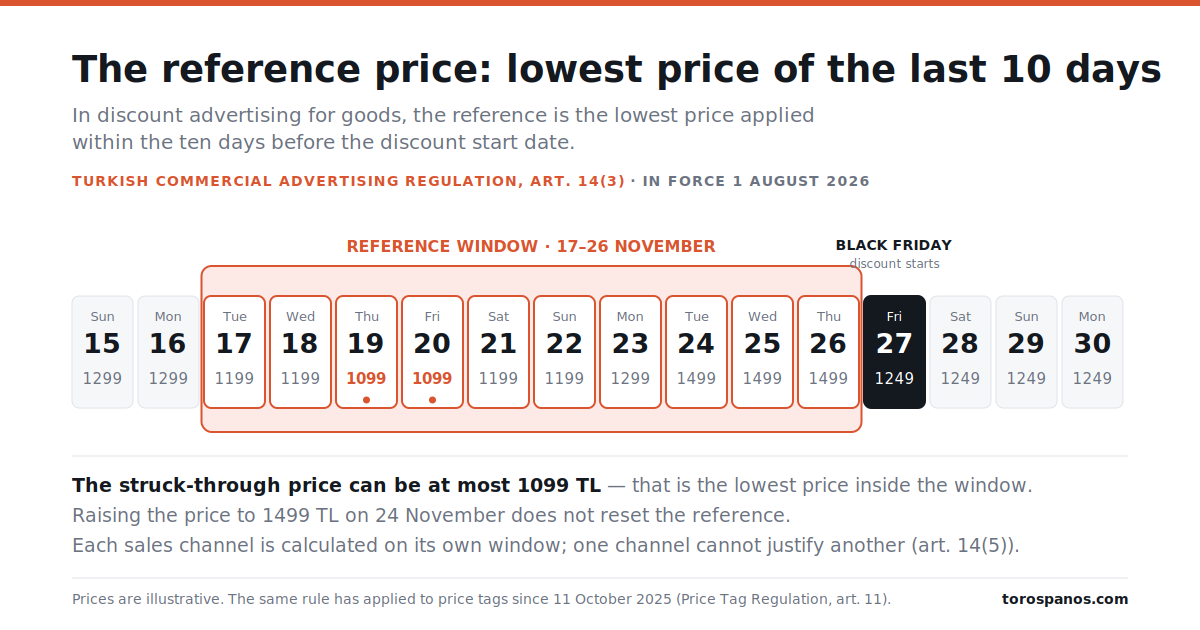

If you sell into Turkey, the price you strike through in November is no longer a number you choose. Since 1 August 2026, discount advertising for goods must take as its reference the lowest price you applied in the ten days before the discount start date. A discount starting on 27 November is measured against 17–26 November. That window opens in November — but the pricing decisions that fill it are being made now.
This is an operations piece, not a legal commentary: what the rule says, what changed for multi-channel sellers, which window applies to which campaign date, and what to do before the campaign opens.
What the rule says
The change came with the amendment to the Regulation on Commercial Advertising and Unfair Commercial Practices, published in the Turkish Official Gazette on 1 July 2026 (issue 33297) and in force from 1 August 2026. Article 14(3) now reads, in translation:
“In determining the price before the discount, for advertisements relating to the sale of goods, the lowest price applied within the ten days preceding the start date of the discount shall be taken as the basis; for advertisements relating to perishable goods such as fruit and vegetables, and to services, the price immediately preceding the discounted price shall be taken as the basis.”
Two regimes, then. Durable goods are measured against the lowest price in a ten-day window. Services and perishables are measured against the price immediately before the discount. An e-commerce business selling physical products falls under the first.
Two phrases carry the weight. “Lowest” — not the average and not the most recent price in the window, but the floor. And “preceding the start date of the discount” — the window counts back from the day the discount goes live, not from the day the campaign is announced.
The price-tag side changed a year earlier
This did not arrive alone. The same calculation entered Turkey’s Price Tag Regulation on 11 October 2025 (Official Gazette issue 33044), which replaced the previous thirty-day basis with the ten-day lowest price for price tags, tariffs and price lists. That amendment took effect on its publication date.
So between October 2025 and August 2026 sellers were working to two different numbers: ten days on the tag, thirty days in the advertisement. 1 August 2026 closed that gap. In practice: the struck-through price on your product page and the discount claim in your ad copy now draw on the same window. There is no longer room to get one right and leave the other on the old habit.
The part that is genuinely new: each channel carries its own window
The same amendment added a fifth paragraph to Article 14, and it matters to anyone selling through more than one channel. Where a product is offered through different sales channels, the pre-discount reference is determined by looking only at the price in the channel where the discount is run. The paragraph closes with an explicit prohibition: a price applied in one sales channel cannot serve as the basis for a discounted sale in another.
A worked example:
- On your own site the product sits at 1,499 TL throughout November.
- On the marketplace you dropped it as low as 1,099 TL between 17 and 26 November.
- On 27 November you open a campaign on the marketplace.
Your reference on the marketplace is 1,099 TL. The 1,499 TL from your own site is not available to you as a struck-through price in that channel — and the reverse holds too. Each channel is calculated against its own price history.
The operational consequence catches most sellers unprepared: you need to be able to reconstruct price history per channel. If you work from one central price list and push it out to channels at different discount rates, you have to be able to show which price was live in which channel on which day. The regulation does not separately impose a record-keeping duty; but in practice there is no other way to calculate the correct reference price, or to show your working if the claim is questioned.
“Discount” is broader than you think
Two further paragraphs added to Article 14 extend the rule past the classic percentage-off promotion.
Loyalty programme prices
Paragraph six brings advertisements for loyalty schemes — those set up to strengthen the customer relationship or encourage purchase — under the same article, where the programme is easily accessible or usable by consumers. If you announce a “members-only price” and membership is something anyone can obtain without friction, how easily that membership is obtained becomes the deciding factor.
Conditional offers
Paragraph seven covers advertisements that make a discount or other benefit conditional on the consumer buying a certain quantity, number, value or quality of goods, or performing a certain transaction. These are precisely the November staples:
- “20% off orders over 3,000 TL”
- “Buy 2, pay for 1” / “Buy 3, pay for 2”
- “Extra discount in basket”
- Bundle pricing on specific combinations
The paragraph carves out the rules on displaying quantity. So how the count is presented in a “buy 2, pay 1” offer is a separate question; the basis for the price claim falls under Article 14.
Window calendar for November 2026
The window is the ten days back from the day the discount goes live. Turkey’s main November campaign dates and the windows they map to:
| Campaign | Discount starts | Reference window (10 days) |
|---|---|---|
| 11.11 | Wednesday 11 November 2026 | 1–10 November |
| Early November opening | Friday 20 November 2026 | 10–19 November |
| Black Friday (Efsane Cuma) | Friday 27 November 2026 | 17–26 November |
| Cyber Monday | Monday 30 November 2026 | 20–29 November |
Note the overlap. The low price you run on 11.11 sits inside the window for a campaign opening on 20 November. The price you run on Black Friday sits inside Cyber Monday’s window. For a product entering more than one November campaign, this means each campaign drags down the floor of the next one. An aggressive discount early in the month limits the struck-through price you can show mid-month; and the last campaign of the month is working from the dirtiest window of all.
Which is why November is planned as a sequence rather than as a single event: which product enters which campaign, at what price, and where the struck-through price lands at the end of that order. The unit economics decide how far down you can actually go.
Why pre-campaign price inflation stops working
The familiar move is to raise the price a week before the campaign and show a bigger discount on the day. The ten-day window breaks this from two directions.
First, because the lowest price in the window governs, the low price before the increase keeps setting the reference until it falls out of the window. Raising the price to 1,499 TL on 24 November does not make 19 November’s 1,099 TL disappear.
Second — and this is the subtler part — shortening the window from thirty days to ten looks at first like it makes inflation easier: you only have to wait ten days for an old price to drop out, not thirty. But the November calendar will not give you those ten days. Black Friday’s window opens on 17 November, immediately after 11.11. To keep that window clean you would have to raise the price before 17 November, which means sitting expensive in the middle of the month while demand is live. The design does not make inflation impossible; it makes it expensive.
Enforcement
Discount advertising falls to Turkey’s Advertisement Board (Reklam Kurulu). The ceilings for administrative fines are revalued annually and vary by medium. Among the 2026 upper limits stated in the Ministry of Trade’s announcement of 31 May 2026: 8,635,800 TL for internet advertising and 31,808,530 TL for television. These are ceilings; the amount actually imposed depends on the nature of the breach and on repetition.
For most sellers, though, the sharper risk comes before the fine: the Board can also order an advertisement stopped. An ad pulled in the middle of a campaign means losing the campaign itself.
Pre-campaign checklist
- Start recording daily prices per channel. Because November’s windows overlap, a single ten-day record is not enough; a record covering the whole month lets you see which window applies to which campaign. Pull it from the marketplace panel or your integration’s price history — and if that is not available, start logging daily from today.
- Compute the lowest price in the window for each SKU. Ten days back from your intended campaign start. That figure is the ceiling on the struck-through price you can show.
- Sequence campaigns by price. Since an earlier campaign sets the floor for a later one, where you place your deepest discount is a real choice: go deep early and later campaigns show a smaller markdown; leave it to the end and that campaign’s own window is already full of earlier discounts. Picking one “showcase campaign” per product and staying shallower in the others gives a cleaner result than either.
- Put conditional offers and member prices on the same list. “20% over 3,000 TL” and members-only pricing fall under Article 14 too — do not build them assuming they are out of scope.
- Match ad copy to the product page. In automated formats such as search and Performance Max, promotional text is drawn from the feed; the discount rate in the feed and the struck-through price on the page must rest on the same calculation.
- Keep price history on your own storefront. WooCommerce and similar setups do not log price changes by default. A simple table storing each day’s price with a timestamp is the only thing you will be able to show retrospectively.
- Plan the campaign exit as well. Your post-campaign price enters the next campaign’s window. If December campaigns are in the plan, November’s closing price matters.
Frequently asked questions
The answers below summarise how the regulation bears on seller operations; take advice from your own counsel on a specific campaign design.
Is the ten days counted from the announcement or from the discount start?
The paragraph says “the ten days preceding the start date of the discount”. Announce on 10 November and go live on 27 November, and the window is 17–26 November.
I ran a one-day flash discount inside the window and came back up. Does that price count?
The paragraph takes the lowest price in the window and draws no distinction based on how many days a price was applied. On that wording, a single-day flash discount should be expected to set the reference.
I sell services. Does the ten-day rule apply to me?
No. For services and perishable goods such as fruit and vegetables, the basis is the price immediately preceding the discounted price. Where the goods/services line is not clean — subscriptions, bundles that include a service — you will need to work out separately which regime you are in.
Can I use my marketplace price as the struck-through price on my own site?
The paragraph states that a price applied in one sales channel cannot be taken as the basis for a discounted sale in another. Each channel has to be calculated against its own price history.
If the marketplace runs the campaign, who is responsible?
Complying with a platform’s own price-tag and campaign rules does not mean you have complied with the regulation; both have to hold. How responsibility is shared between seller and platform depends on the contract and on the facts, so no general answer applies here. The practical point: you are the party approving the price on the campaign enrolment screen.
Sources
- Regulation Amending the Regulation on Commercial Advertising and Unfair Commercial Practices — Turkish Official Gazette, 1 July 2026, issue 33297 (in force 1 August 2026)
- Regulation Amending the Price Tag Regulation — Turkish Official Gazette, 11 October 2025, issue 33044
- Turkish Ministry of Trade — statement on Advertisement Board decisions, 31 May 2026 (2026 upper limits by medium)
The one thing to do this week
Start recording daily prices per channel for the products you intend to put into a campaign. Black Friday’s reference window opens on 17 November; if you have not started logging by then, you will not be able to calculate the struck-through price you are allowed to show on 27 November. Everything else — discount depth, campaign sequencing, ad copy — comes out of that record.
Note: this article explains how the regulation bears on seller operations and is not legal advice. Quotations from the regulation are working translations of the Turkish text as it stood on the publication date; the Turkish original governs.
Haftalık bülten
Pazaryeri ve e-ihracatta bu hafta ne değişti?
Komisyon oranları, mevzuat ve algoritma değişikliklerini haftada bir, tek e-postada özetliyorum. Reklam yok, tekrar yok — istediğiniz an tek tıkla çıkabilirsiniz.
