



Last updated: Rules, fees and platform policies change. This guide is reviewed and kept current.
Search behaviour changed quietly over the last two years. People no longer type “best wireless headphones” and open ten blue links one by one; they read Google’s AI summary, they tell ChatGPT “recommend noise-cancelling headphones under 300 dollars and explain why you picked that one”, they scan the sources in Perplexity. The consequence: you can be visible without getting a click — or you can be invisible entirely.
There is still no agreement on what to call this new layer; some say AEO (answer engine optimisation), others GEO (generative engine optimisation). The name does not matter. What matters is this: the rules of classic SEO have not been thrown away, but a new criterion has been added — citability.
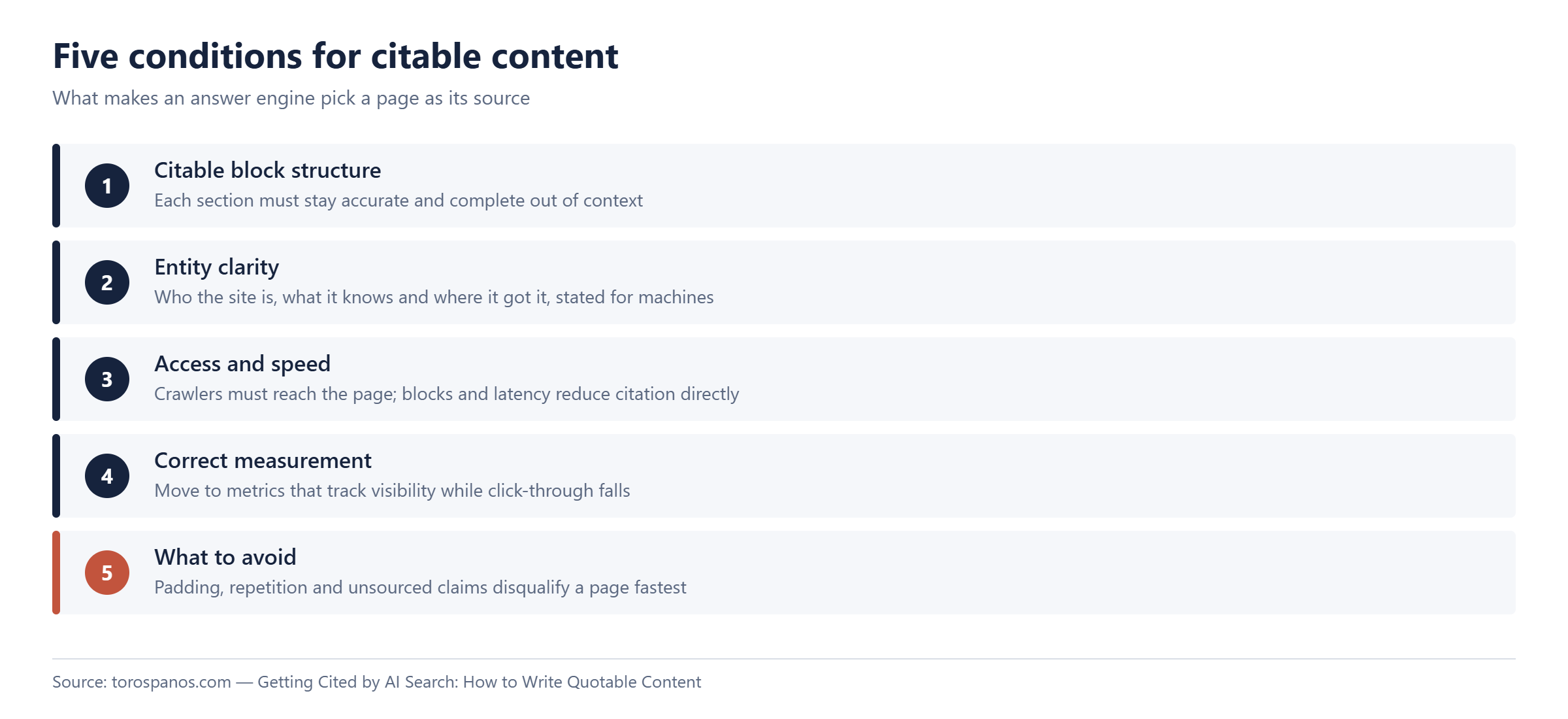
Five conditions for citable content
What makes an answer engine pick a page as its source.
- Citable block structureEach section must stay accurate and complete out of context
- Entity clarityWho the site is, what it knows and where it got it, stated for machines
- Access and speedCrawlers must reach the page; blocks and latency reduce citation directly
- Correct measurementMove to metrics that track visibility while click-through falls
- What to avoidPadding, repetition and unsourced claims disqualify a page fastest
Why does an AI cite one source and not another?
When a language model produces an answer, it tries to pull the information it is going to make a claim about from sources that are as clear, as verifiable and as internally consistent as possible. In practice, the content that gets cited shares these traits:
- The answer is at the top. The response to the question is given in the first paragraph; the reader does not have to scroll three screens.
- The claim is specific. Not “it is very fast” but something measurable, like “first load stays under two seconds”.
- The structure can be broken apart. Headings, short paragraphs, lists and tables mean a single section can be lifted out of its context and quoted.
- The source is stated. Where the number, the date and the comparison came from is written down explicitly.
- The author is identifiable. The page has a real writer, a real organisation and a way to make contact.
Not one item on that list is an AI-specific trick. All of them are simply the definition of good content. The difference is that badly structured good content used to rank anyway; now unstructured content falls outside the citation chain.
Page structure: the “citable block” pattern
Build every important page out of blocks that can be copied independently of one another. A practical template:
- A question heading. At H2 level, in the form the user actually typed: “Is the shipping fee refunded?”
- A direct answer in two sentences. Conditions and exceptions immediately after.
- Detail. Reasons, an example, edge cases.
This template works both for the AI and for the human in a hurry. Pages that do the reverse — three paragraphs of preamble, then a definition, and the answer right at the end — lose the reader and drop down the queue when summaries are generated.
Entity clarity: telling the machine who your site is
Models work with entities rather than words: people, organisations, products, locations. Defining those entities consistently across your site is the precondition for a correct sentence being written about you.
- Take the About page seriously. Who, since when, on what subject, with what evidence. A three-line “we are a passionate team” does nothing.
- Create author pages. A short biography, the area of expertise, links to external profiles where they exist. Even on a one-person blog this shows there is a human behind the content.
- Add schema markup. Organization/Person, Article, Product, FAQ and BreadcrumbList. If you use WordPress, your SEO plugin generates most of this automatically; checking that the output is correct is still on you.
- Write your name and description identically everywhere. On the site, on social profiles, in directories. Inconsistent naming breaks entity matching.
The technical side: access and speed
To be cited you first have to be readable. Three checks:
You may have blocked the AI crawlers. Some security plugins and CDN rules block user agents such as GPTBot, ClaudeBot and PerplexityBot by default. Make the decision deliberately: if you want your content to appear in AI answers, allow access; if you do not, close it off explicitly in robots.txt. A configuration stuck between the two is the worst of both.
Do not hide content behind JavaScript. Text loaded by a component that only runs in the browser is invisible to many crawlers. Critical content has to arrive in the HTML.
Page speed still matters. LCP under 2.5 seconds, INP under 200 ms, CLS under 0.1 — those thresholds hold for user experience and for crawl efficiency alike.
Measurement: how do you see success while clicks fall?
Measurement is the most irritating part of this area. Appearing in AI summaries does not always bring a click, so the classic traffic chart paints an incomplete picture. Track these instead:
- Branded searches. The impression and click trend for queries containing your brand name in Search Console. Appearing in AI answers usually lifts branded search first.
- The impression/click gap. If impressions are rising while clicks stay flat, your content may be being used in summaries.
- Direct and referrer-less traffic. Some visits from chat interfaces land in this bucket.
- Manual testing. Once a month, ask the popular assistants the ten typical questions in your field and note who gets cited. Tedious, but it is the most honest data you will get.
What to avoid
Because the area is new, there is a lot of advice circulating that sells a quick fix. Two to watch out for.
Wholesale AI-generated content with no sources. What models look for in order to cite is original data, experience and a verifiable claim. Pages that rewrite the same general knowledge convince neither the human nor the machine.
Relying on technical files alone. Proposals like llms.txt are interesting and adding one does no harm, but none of them make the content itself citable. The order of priority is always the same: correct information, clear structure, then technical detail.
In short: preparing for AI search is not learning a new game, it is playing the same game with more discipline. Pages that answer questions directly, say clearly who they belong to, and can be read by a machine show up both in today’s rankings and in tomorrow’s answers.
An example: the same section, two ways
The version that does not get cited: “Shipping processes have always been a subject of debate in the world of e-commerce. Many sellers follow different policies on this topic, which is critical for customer satisfaction. So what happens in the case of a return? In this post we will examine the issue.”
The version that does: “If the product arrived defective, the seller covers the return shipping cost. If the customer is exercising a right of withdrawal, who pays depends on the return policy the seller published in advance; where no policy was published, the burden falls on the seller.”
The second text is shorter, feels less like “content”, and is useful to both the reader and the model for exactly that reason. Giving up the habit of writing an introductory sentence is the hardest and most rewarding step in this work.
A 30-day implementation plan
- Week 1: list your ten highest-traffic pages. Ask each one “what question does this page answer?” and move the answer into the first paragraph.
- Week 2: write the About and author pages. Check the schema output and fix fields that are wrong or missing.
- Week 3: check crawler access: robots.txt, security plugin rules, CDN blocks. Turn your decision into a written policy.
- Week 4: ask the assistants the ten typical questions in your field and record who gets cited. This becomes the raw material for the next three months of your content plan.
At the end of a month you will not have a magic jump; you will have a core of content that has become citable both in search results and in answer engines. In this area the winner is not whoever moves fastest but whoever publishes most consistently.
Related reading
- Page speed, the technical precondition for citability: the WooCommerce speed optimisation checklist.
- Building the paid side alongside organic visibility: the Performance Max guide.
Sources and official links
- Google Search Central — AI Features and Your Website — Google’s statement that there is no separate optimisation for AI features
- Google Search Central — Creating Helpful, Reliable, People-First Content — The people-first content criteria
- Google Search Central — Spam Policies — Scaled content abuse and its consequences
- Google Search Central — Intro to Structured Data — The fundamentals of structured data markup
- Google Search Central — Supported rich result types — The current list of supported rich result types
Rules, fee schedules and platform policies change. The figures in this post reflect the position at the time of writing; confirm the current position from the official sources above before you act.
Haftalık bülten
Pazaryeri ve e-ihracatta bu hafta ne değişti?
Komisyon oranları, mevzuat ve algoritma değişikliklerini haftada bir, tek e-postada özetliyorum. Reklam yok, tekrar yok — istediğiniz an tek tıkla çıkabilirsiniz.
