


Last updated: Rules, fees and platform policies change. This guide is reviewed and kept current.
Turkey’s micro-export limit has changed, and most of the content online states it with the wrong date. The correct figures: 600 kilograms gross and 30,000 euros. The change was made by a Communique (Series No: 5) published in the Official Gazette of 3 January 2026, issue 33126, and it took effect on the date of publication. The relevant article reads, verbatim: the expression “300 kilograms” in paragraph seven of Article 10 of the same Communique has been changed to “600 kilograms”, and “15,000 Euros” to “30,000 Euros”.
So the old limits — 300 kg and 15,000 euros — doubled. The dates that circulate frequently in Turkish sources (“4 December 2025”, “5 December 2025 / Official Gazette 10664”, “25 December 2025”) are not correct, and figures like “300,000 dollars” are not correct at all. Knowing the right reference is not merely pedantry — when you talk to your customs broker or your carrier, knowing which text you are referring to speeds the job up.
A note for international readers: this is a guide to Turkey’s micro-export regime. ETGB is the simplified electronic customs declaration used for postal and express-courier exports from Turkey, and the rules, support schemes and tax mechanics below are Turkish. If you are exporting out of Turkey — whether you are based there or working with a Turkish supplier — this is the paperwork layer you will meet.

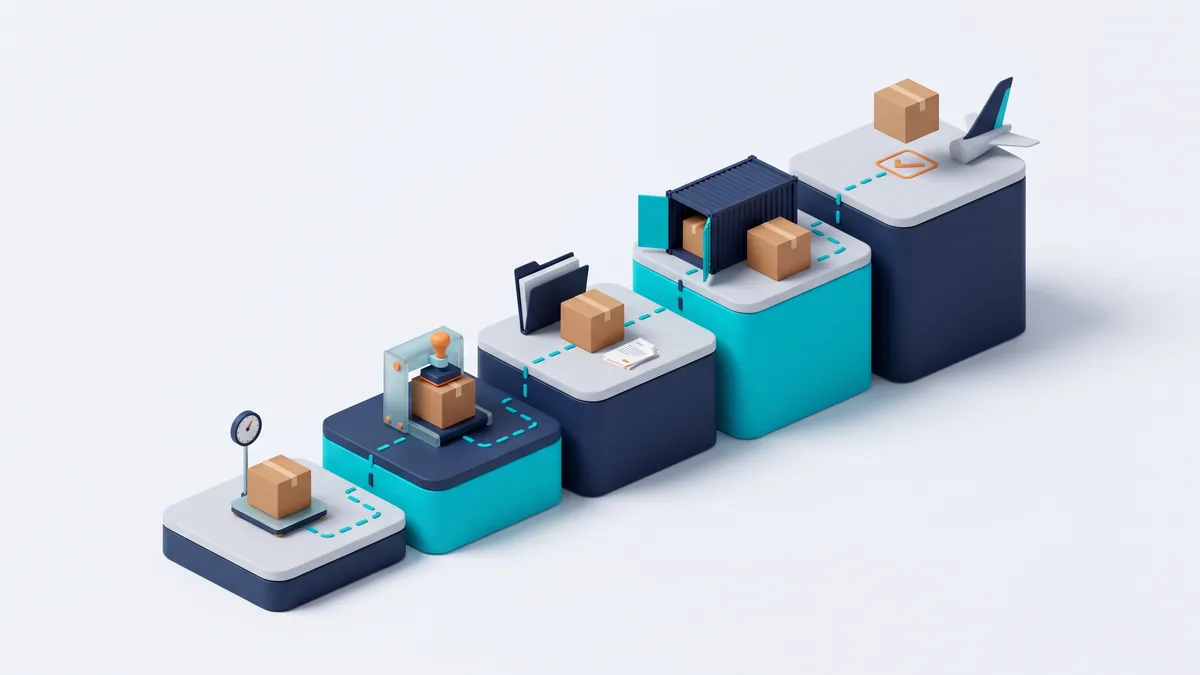
Micro-export: the ETGB process in five headings
The limit rose to 600 kg and EUR 30,000 on 3 January 2026.
- Filing the ETGBThe courier can file as indirect representative; the alternative is your own broker
- VAT refundPossible with the ETGB; the document is sufficient on its own
- What 2026 changedThe raised limit and the automatic e-A.TR are two of three changes
- Repatriating export proceedsObligation to sell to the central bank, and the deadlines that apply
- Government incentivesCheck which are still active before you build a plan around one
What is ETGB, and who files it?
ETGB — Elektronik Ticaret Gümrük Beyannamesi, the Electronic Commerce Customs Declaration — is the simplified declaration used for exports sent by post and express courier. The most misunderstood part: you do not file it.
Article 10(7) of the relevant Communique (Series No: 1, Official Gazette 22/4/2022 – 31817) says the declaration is made by the “operator”. The operator is an express courier company or postal administration that has been granted indirect representation authority by the Ministry of Trade. So in ETGB exports you do not contract directly with a customs broker or fill in the declaration yourself; your carrier does it on your behalf.
That has two practical consequences. First, the administrative barrier to starting micro-export is genuinely low — the process runs through signing up with a carrier. Second, most of the errors in the process are not under your control: if the invoice details, the HS code or the recipient information go across wrong, the declaration is filed incorrectly, and correcting it afterwards is much harder. Data quality before dispatch is the only real control point in micro-export.
One warning: the list of authorised operators is published by the Ministry of Trade and it changes. Rather than learning from a third party that a given company is authorised, verify against the current list published by the Directorate General of Customs.
VAT refunds: possible with ETGB, and the document is enough
This is the most-asked question about micro-export and the one with the clearest answer. A published ruling from the Turkish Revenue Administration sets the position out explicitly.
In the export exemption section of the VAT General Application Communique, the documents required for a refund include: “the customs declaration or list (… in exports carried out by post or courier, the electronic commerce customs declaration)”. The conclusion of the ruling is reassuring on procedure: exports made by post and express courier can be substantiated with the ETGB approved electronically by the customs directorate and transferred into the VEDOP system, and for substantiation a printout of the ETGB submitted to the tax office is sufficient — a wet-signed and stamped ETGB is not required.
So the ETGB printout is enough; no wet signature or stamp is sought. The refund is available both on a manufacturer’s export-registered deliveries (VAT Art. 11/1-c) and for an exporter who buys with VAT paid and then exports.
A related but separate matter: the export proceeds arriving at the bank and the İBKB/DAB document chain. Because the health of your refund file depends on that chain, a setup where you never bring marketplace payments into your Turkish bank account can create problems on the VAT refund side. The thresholds and exceptions here (such as the amount below which İBKB/DAB is not issued) are governed by the Central Bank’s Export Circular, and I am deliberately not writing a specific figure — the text changes periodically, and a wrong number means losing money directly. The concrete question to put to your accountant: “At my shipment volume, is an İBKB/DAB required, and if not, how do we build my VAT refund file?”
And the corporate tax side
Article 32(7) of the Corporate Tax Law reads: for corporations that export, the corporate tax rate is applied with a five-point reduction on earnings derived exclusively from exports. With the general rate at 25%, export earnings are taxed at 20%.
There are two critical limits. First, this provision is for corporations — limited and joint-stock companies. There is no equivalent for a sole proprietorship. Second, during 2026 a new Corporate Tax General Communique was published governing how these reductions interact with one another, and the mechanism changed. So do not plan on the assumption “I export, therefore I will pay 20%”; have your accountant do the calculation. If you are at the stage of choosing a company type, this article is one of the real inputs to the decision.
Three things that got easier in 2026
Besides the limit increase, three regulations took effect during the year that make micro-export directly easier.
Automatic e-A.TR — since 3 July 2026. For consignments to the EU not exceeding 150 euros in value under a simplified customs declaration, the A.TR Movement Certificate is now generated automatically and electronically. The Ministry of Trade introduced this on the grounds of “preventing additional financial burdens” after the EU removed the customs duty exemption on consignments under 150 euros on 1 July 2026. Courier and postal operators authorised by the Ministry can use it.
Air transit procedures simplified — from 18 August 2026. Micro-export consignments under a simplified declaration can be moved to hub airports using “fast and simplified” transit procedures. In practice this shortens transit time on multi-channel shipments.
A customs broker requirement for operators. The 3 January 2026 Communique introduced a rule that operators must employ, or contract with, at least two customs brokers; that article took effect 90 days after publication (early April 2026). The Ministry retains the power to change that number. What it means for the seller: declaration quality on the operator side is becoming more institutional.
Note: the Ministry of Trade’s published “Micro Export Customs Guide” is a useful source, but it is dated November 2023 — before the January 2026 limit change. The guide’s structure holds; its figures do not. Keep that in mind while reading it.
Repatriating export proceeds and the sale to the Central Bank
This concerns everyone who exports, and it is the item that changes most often. The mechanism: a set percentage of export proceeds tied to an Export Proceeds Acceptance Document (İBKB) or Foreign Exchange Purchase Document (DAB) is sold to the bank that issued the document; the bank sells it on to the Central Bank and pays you the lira equivalent the same day.
The rate has changed several times in recent years — 40%, 30%, 25% and back to 35%. As of August 2026 the rate in force is 35%, and a Ministry of Treasury and Finance letter set that it applies until 31 January 2027. If it is not extended, the permanent provision in the circular returns the rate to 25%.
A caveat on writing that number down: the rate is re-set by ministry letter at roughly three-month intervals. What is correct today can be wrong in three months. If you are tying your cash flow plan to this rate, put a “check every quarter” item inside the plan and verify the current rate from the foreign exchange section of the Central Bank’s Export Circular.
Government support schemes: which are active, which were withdrawn?
The umbrella for e-export support is Decision No. 5986 on E-Export Supports, dated 24/8/2022 and, according to the consolidated text, last amended by the Official Gazette of 17/1/2026. The support headings it covers:
- Market entry and report support
- Digital marketplace promotion support
- E-export promotion support
- Order fulfilment service support
- Overseas marketplace integration support
- Online store, e-commerce consultancy and partner services
- Marketplace commission support
- E-export promotion project and e-Export Consortium
The support rate is generally 50%; the duration on most items is three years per marketplace or country; total support cannot exceed 75% of eligible expenditure. The annual caps are lira-denominated and re-indexed every January — which is why I am not giving a lira figure here. The current table is published in the caps file on the Ministry of Trade’s “E-Export Supports Circular Annexes” page.
The critical detail most sources skip: on that same page the Ministry publishes two official lists — a “List of Companies Providing Order Fulfilment Services” and a “Marketplace / E-Commerce Site List”. To benefit from support, the service provider or marketplace you use has to be on those lists. So if you plan to claim support, checking that list while choosing your fulfilment company and your marketplace is much cheaper than having an application rejected later. Applications run through the DYS (Support Management System).
One heading that is no longer valid: the scheme known as “support for membership of e-commerce sites”, under the old Decision No. 2573, has been repealed. Decision No. 5973, which replaced it, contains only transitional provisions for previously approved applications. E-commerce and marketplace supports now sit under 5986. There is a great deal of Turkish content still presenting that heading as active; check the decision number before applying.
On the general market-entry side, Decision No. 5973 on Export Supports is in force: Market Entry Certificate Support, Overseas Market Research Support and Market Entry Project Preparation Support are all listed at 50%. The lira caps on these items are also indexed annually.
A one-week setup plan
Starting micro-export is not as long a process as people assume. The sequence matters.
- Monday: settle your company type and the tax side. Put three questions to your accountant together: (a) is an İBKB/DAB required at my volume, (b) how do we build my VAT refund file with ETGB, (c) can I benefit from the five-point corporate tax reduction? Those three answers are the foundation for every later step.
- Wednesday: talk to two or three authorised courier operators. What to ask: the ETGB filing flow, total cost per shipment (including fuel surcharge), delivery times in your target countries, and whether they use the automatic e-A.TR mechanism on EU consignments. That last question matters — if they do not, you lose the customs union advantage in practice.
- Thursday: prepare your product data. For each product: the correct HS code, an English product description, gross and net weight, country of origin. Built properly once, this table gets reused on every shipment; built wrongly, it produces risk on every shipment.
- Friday: send a single test shipment. The goal is to learn the process, see how the ETGB arrives, and watch how the proceeds land at the bank. Everyone who starts with dozens of shipments gets a surprise on the first invoice.
- The following week: assess the support application. Which headings under 5986 fit you, and are the marketplace and fulfilment company you use on the Ministry lists? Open your DYS registration at this stage — support does not work retroactively.
What I did not write
Some numbers are deliberately absent from this post, because publishing an unverified figure is more harmful than publishing none. Things to verify from your own source:
- İBKB/DAB thresholds and the exemptions specific to micro-export. The current text of the Central Bank’s Export Circular governs.
- Whether a micro-export invoice should be an e-Archive invoice or an export e-Invoice. Common practice points towards e-Archive, but I have not verified this from a primary Revenue Administration source; ask your accountant.
- Exporters’ association dues and the approval code question. I could not find a current primary source on the proportional dues treatment for ETGB consignments.
- The 2026 support caps (in lira). Indexed every January; take them from the current file on the Ministry page.
- Marketplace commission and onboarding conditions (Etsy, Amazon Global Selling, eBay). These change often; read them on the platform’s own seller help pages.
Setting the expectation correctly
The limit rising to 30,000 euros takes micro-export out of the “hobby scale” category. Shipments six times larger can now be made with the same declaration convenience, and with automatic e-A.TR there is a mechanism in place against the cost increase on the EU side.
But this needs saying too: micro-export is a customs convenience, not a market. Simplifying the declaration does not change your VAT obligations in the destination country, product safety legislation, your returns logistics, or whether there is demand there at all. The part that got easier is the paperwork; the hard part is still selling.
The right order: start with one country, one channel and small volume; learn the process; then scale. The people who lose in this area are not the ones who started late — they are the ones who opened six countries at once because the paperwork got easier, without doing any market research.
Related reading
- Before you decide which market to open: market selection in cross-border e-commerce and the 2026 customs reality.
- When moving to a model with storage abroad: Amazon FBA or FBM?
- So you do not start exporting before the unit economics are built: calculating real profit margin.
This post is for information only; it is not tax or customs advice. Sources: Official Gazette 3/1/2026 – 33126 (Communique Series No: 5), Official Gazette 22/4/2022 – 31817 (Communique Series No: 1), a Revenue Administration ruling, Ministry of Trade e-export support pages and announcements, and the Central Bank Export Circular. All as of August 2026. Legislation changes frequently; consult your accountant and customs broker before transacting.
Sources and official links
- Official Gazette — Amendment raising the micro-export limits, 3 January 2026 — The 3 January 2026 communiqué raising the limit to 600 kg and EUR 30,000
- Official Gazette — Communiqué No. 1 on customs procedures for post and express cargo — The base communiqué (art. 10/7) and the returned-goods rules
- Ministry of Trade Customs Guide — What is an ETGB? — The official definition of ETGB and its link to tax refunds
- Directorate General of Customs — Simplified Customs Declaration guide — The operational guide to the simplified customs declaration
- Turkish Revenue Administration — VAT General Implementation Communiqué — Export exemption and the procedure for VAT refunds
- Ministry of Trade — E-export support programmes — E-export support programmes under Decision No. 5986
Rules, fee schedules and platform policies change. The figures in this post reflect the position at the time of writing; confirm the current position from the official sources above before you act.
Haftalık bülten
Pazaryeri ve e-ihracatta bu hafta ne değişti?
Komisyon oranları, mevzuat ve algoritma değişikliklerini haftada bir, tek e-postada özetliyorum. Reklam yok, tekrar yok — istediğiniz an tek tıkla çıkabilirsiniz.
