




Last updated: Rules, fees and platform policies change. This guide is reviewed and kept current.
On a marketplace, the seller score is not a performance certificate sitting in your dashboard. It is the strongest non-price variable determining which of the ten people selling the same product as you makes the sale. Trendyol says so plainly: a high seller score positively affects product ranking and buybox ranking. Which means that when your score falls, your revenue falls even if your ad budget and your price stay exactly the same.
Despite that, most sellers only notice the score once it has turned red. Below we work through, in order, which metrics make up the score, what happens at which threshold, and which metric is systematically misunderstood, based on official sources.
A note for international readers: Trendyol and Hepsiburada are Turkey’s two largest marketplaces, and the rules below are theirs. The structure (category-relative scoring, weighted windows, violation points) will be familiar to anyone selling on Amazon or a similar platform, but the specific thresholds are Turkey-specific. All data is as of August 2026, taken from the platforms’ own documentation; thresholds like these change, so the source is named in each section.
| Metric group | Items | Calculation window |
|---|---|---|
| Customer metrics | 5 | 100% of the last 3 months |
| — seller and product ratings, complaint rate | ||
| — question response time, return resolution time | ||
| Operational metrics | 6 | 70% last month + 30% last 3 months |
| — failure to supply, incorrect or defective returns | ||
| — dispatch and on-time delivery, disputed returns, violation points |
Trendyol: the 11 metrics that make up the score
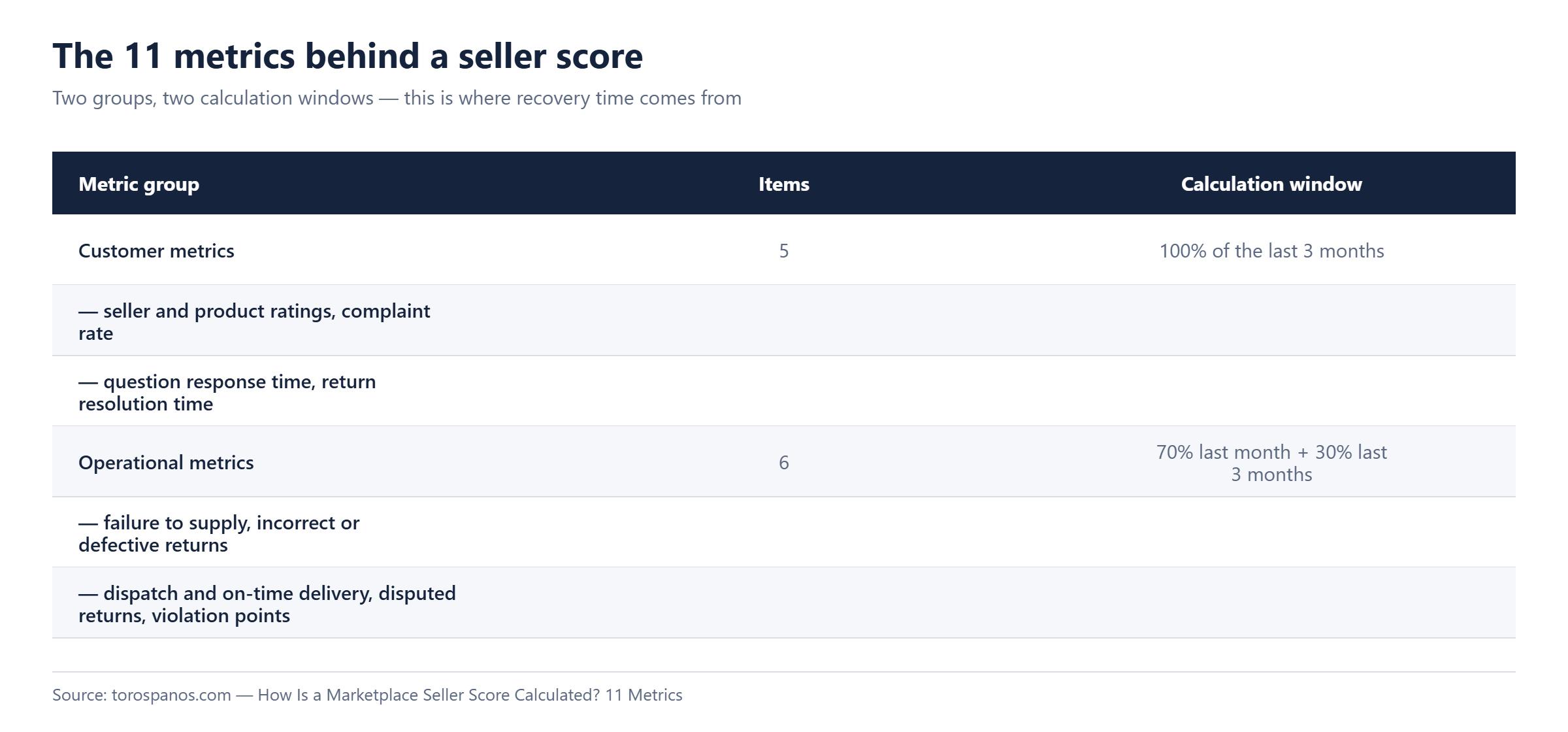
Trendyol groups the seller score into two sets. Customer metrics, five items: seller reviews, product reviews, customer complaint rate, question response time, time to process a return. Operational metrics, six items: failure-to-supply rate, missing/defective/wrong return rate, time to hand over to the carrier, on-time carrier handover rate, disputed return rate, violation score.
The weighting is what matters. Most operational metrics are calculated as 70% of the last month plus 30% of the last three months. The four customer-side metrics are 100% of the last three months. The practical meaning: you can make up for an operational mistake within a month, but a deterioration in customer reviews or complaint rate follows you for three.
The colour bands are published officially:
- 9.0 – 10: Outstanding (dark green)
- 8.5 – 9.0: Successful (green)
- 8.0 – 8.5: Could Be Better (light green)
- 7.0 – 8.0: At Risk (orange)
- Below 7.0: High Risk (red)
The calculation mechanics affect operational planning too: the score is computed every Tuesday evening and appears in the dashboard and on product detail pages on Wednesday. So the earliest you will see the effect of a fix you make today is next Wednesday, and when people do not know that, they say “I fixed it and nothing happened” and make the next wrong intervention.
A score requires at least five delivered orders and 15 days since the first order; the evaluation window runs from 7 to 97 days. And the detail most often missed: scoring is category-based. In Trendyol’s words, a seller’s performance is scored by comparing it against the average performance of other sellers in the same category. Your target is therefore not an absolute percentage but beating the average in your category. That is good news for sellers in categories like apparel where the return rate is structurally high; in a category with very low return rates, falling below average is easier than you think.
The most misunderstood metric: disputed return rate
The denominator for this metric is not your total returns. Trendyol’s definition: disputed returns where the customer was found to be in the right, divided by total disputed returns. And Trendyol gives this warning in its own FAQ: if there are no returns at all where you were found to be in the right, the rate is calculated as 100%.
The consequence: a seller shipping three thousand orders a month can bottom out on this metric if they lose a single disputed return. The right reflex here is not to contest every dispute; it is to focus on the disputes you can defend with documentation and close the indefensible ones quickly. Note also that only returns with a missing, defective or wrong-item reason affect the score; “did not like it” and “wrong size” returns do not enter this metric. Before panicking about a high return rate, break down the return reasons.
Question response time: the nine-hour wall
This metric only counts questions arriving between 08:00 and 20:00; for questions arriving outside those hours the clock starts at 08:00 the next morning, and public holidays are excluded. The threshold is explicit: in Trendyol’s words, replies that exceed nine hours receive the lowest score.
So a routine of checking the question inbox twice a day (morning and afternoon) is enough for this metric. A routine of checking once a day automatically takes the lowest score on some share of the questions that arrive late in the day.
Violation points: the threshold with no way back
Separate from the seller score there is a harsher regime. The violation point tiers:
- 12 points: sales closed for 2 days
- 24 points: 5 days
- 36 points: 7 days
- 48 and above: indefinite suspension, contract termination after 30 days
Two details make this table dangerous. First, the window to appeal is five days from the violation (structured to cover three business days) — so a violation that lands during a holiday is easy to miss. Second, violations expire after 90 or 180 days, except 48-point violations. Once the 48 threshold is crossed, the expiry mechanism does not apply.
The items on the violation list that catch sellers most often are predictable and all avoidable: marking a product “shipped” when it has not been handed to the carrier, sending an empty or sample parcel, opening multiple seller accounts without Trendyol’s knowledge, directing the customer off-platform, fake reviews and likes, altering documents. And a technical one: opening the same product under different barcodes — a “duplicated product” — is a 2-point violation and means the listing gets closed.
Operational performance suspensions and integration risk
There is a third mechanism, independent of both the seller score and violation points. Trendyol tracks three core criteria monthly: failure-to-supply rate, defective/wrong/missing return rate, and on-time carrier handover rate. Sustained poor performance can get a store temporarily suspended from selling for 3, 7 or 30 days.
The real danger here is not the suspension itself but its side effect: during a suspension the stock and prices of all products are zeroed. When the period ends you have to enter them again. If you work through an integration and your integrator has built a “do not send what has not changed” architecture — which is the correct design for performance — your products sit dead at zero stock after the suspension and nobody notices. Any store with a suspension risk needs a full catalogue re-push button ready to go.
It is worth noting that Trendyol does not publish numeric thresholds under this heading: the text only refers to “operational limits determined by Trendyol”. The percentages circulating online have no official basis.
What is different at Hepsiburada?
The single public official page on the Hepsiburada seller score lists eight criteria: post-sale customer reviews, order cancellation rate (seller-caused), order return rate, on-time carrier handover, response time to customer requests, response time to customer questions, complete submission of order invoices, and not sending missing/incorrect/damaged products.
Two differences matter. First, invoice upload is a scoring metric here — it is not at Trendyol. A delay in your accounting flow is written directly into your seller score. Second, “requests” and “questions” are two separate metrics, so a single inbox discipline affects both at once.
On the other hand: Hepsiburada does not publish weightings, numeric thresholds, the score scale or penalty tiers. Statements like “you should target at least 90 points” or “above 95 is a trusted seller” all come from third-party blogs. Making those numbers an operational target means building a plan around an unverified threshold. The right approach is to track your own trend in the dashboard and manage by direction rather than by an absolute number.
Handover deadline: the quiet trap
The standard handover deadline at Trendyol is one business day. It can differ for certain category groups, and the category-based maximums are visible in the dashboard under Operation Settings > Carrier Handover Time Information. Public holidays and Sundays are excluded from the deadline; product-level deadlines are reviewed every six months.
Here is the actual trap: if the “Estimated Delivery Time Display Permission” under Account Information > Permissions has not been granted, customers are shown a 30-day delivery time — but orders are still created with the one-day deadline. So a shopfront figure that damages your conversion rate and an operational deadline that exposes you to late-order risk are running at the same time. Checking that permission is a five-second job and in most stores it has never been looked at.
The order in which to raise the score
Attacking all of it at once does not work, because the metrics have different calculation periods. Start with the items that carry weight and respond quickly:
- This week: set up a question-answering routine. Two fixed check times, morning and afternoon, are enough to stay under the nine-hour threshold. This is the single fastest-acting intervention.
- This week: check the “Estimated Delivery Time Display Permission” and your category-level handover deadlines.
- Within two weeks: fix the failure-to-supply rate at the root. Do a physical stock count, define a safety stock threshold, remove products you cannot actually supply. This metric feeds both the seller score and the suspension risk — you pay for it twice.
- Within a month: separate out your return reasons. Only missing/defective/wrong returns affect the score, and their source is usually incomplete size and material information on the product page, or packaging. Both are fixable.
- Continuously: follow violation notices. A five-day appeal window disappears in an email address nobody checks on weekdays.
What should you measure?
Tracking eleven metrics weekly is not realistic. Three numbers tell you most of what you need to know about the store’s health:
- Failure-to-supply rate. The one item that feeds both the score and the suspension risk.
- On-time carrier handover rate. Remember that orders cancelled by you or the customer after the deadline has passed affect this rate negatively — a customer cancellation does not save you.
- Your buybox win rate. The only indicator that connects the score to money. Trendyol also exposes this through the API: the buybox information service returns your rank, the buybox price and the second and third lowest prices (up to 10 barcodes per request).
Setting the expectation correctly
The seller score is the result of a good operation, not its goal. Every correct thing you do to raise the score — stock accuracy, fast replies, an honest product page, clean packaging — is work worth doing even if the score did not exist. The reverse holds too: trying to manage the score through metric games (fake reviews, empty parcels, multiple accounts) puts you into the violation point regime, and there the threshold has no way back.
One more thing worth saying: in a category-relative scoring system, your competitors are doing the same work. Durable advantage comes not from a one-off fix but from a weekly checking habit. The seller who loses is not the bad seller; it is the seller who only looks at the score once it has turned red.
Related reading
- Continuing to make a profit while protecting your score: calculating real profit margin on marketplaces.
- The full set of technical rules on barcodes, variants and the buybox: the marketplace catalogue management guide.
- Speeding up response times without removing human approval: AI automation in small e-commerce.
The thresholds and metric definitions in this post were compiled as of August 2026 from the Trendyol Seller Information Centre, Trendyol developer documentation and Hepsiburada’s public seller score page. Marketplaces can update these rules without notice; verify on the platform’s own pages before making a critical decision.
Sources and official links
- Trendyol Seller Information Centre — Seller Score — The customer and operational metrics behind the score, their weights and colour bands
- Trendyol Seller Information Centre — Violations — Violation point tiers and the operational suspension thresholds
- Trendyol Seller Information Centre — Handover Deadline — How the handover deadline is defined and why holidays are excluded
- Trendyol — Metrics That Affect the Buybox — How the seller score feeds into buybox ranking
- Amazon Seller Central — Account Health Rating program policy — Amazon’s account health rating as a contrasting metric model
- Hepsiburada Developer Portal — Integration Documentation — Hepsiburada’s official integration documentation
Rules, fee schedules and platform policies change. The figures in this post reflect the position at the time of writing; confirm the current position from the official sources above before you act.
Haftalık bülten
Pazaryeri ve e-ihracatta bu hafta ne değişti?
Komisyon oranları, mevzuat ve algoritma değişikliklerini haftada bir, tek e-postada özetliyorum. Reklam yok, tekrar yok — istediğiniz an tek tıkla çıkabilirsiniz.
