




Last updated: Rules, fees and platform policies change. This guide is reviewed and kept current.
The cost of Amazon FBA is not a single fee. Most sellers build their unit economics on two lines: the referral fee and the fulfilment fee. The real picture has six layers, and the remaining four are the part that quietly eats the margin, because they are charged not at the moment of sale but months later, and only when a trigger condition is met.
Amazon made a commitment for 2026: there will be no new FBA fee types, and the average increase per unit is $0.08 (less than 0.5% of the average selling price). That is the good news. The bad news is that all the existing layers remain in place, and most of them work on trigger logic.
Below I go through the layers one by one. The figures are for the US marketplace as of August 2026, taken from Amazon’s own announcement pages. These schedules change at least once a year; put the numbers in a spreadsheet, not in your memory.
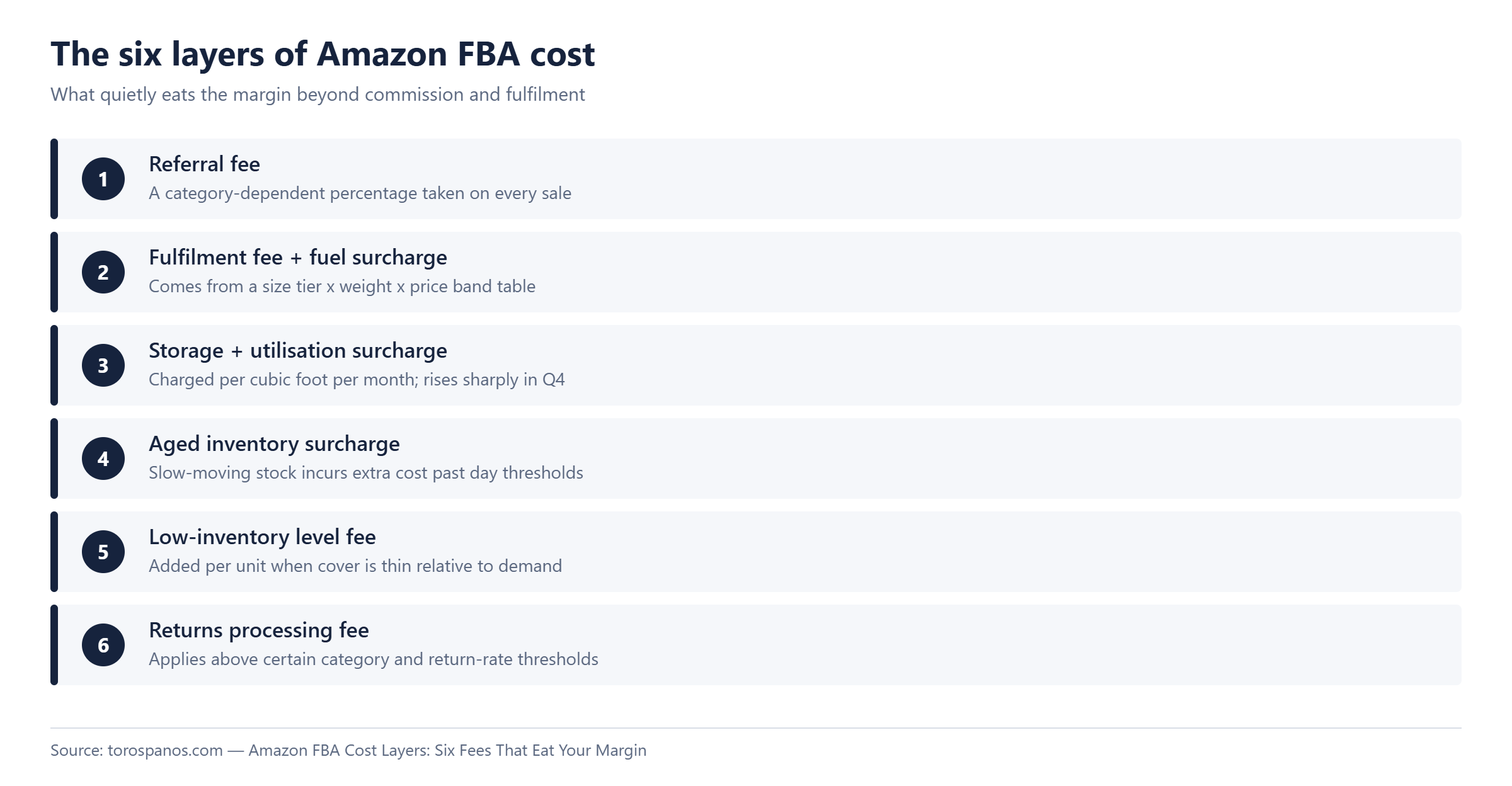
The six layers of Amazon FBA cost
What quietly eats the margin beyond commission and fulfilment.
- Referral feeA category-dependent percentage taken on every sale
- Fulfilment fee + fuel surchargeComes from a size tier x weight x price band table
- Storage + utilisation surchargeCharged per cubic foot per month; rises sharply in Q4
- Aged inventory surchargeSlow-moving stock incurs extra cost past day thresholds
- Low-inventory level feeAdded per unit when cover is thin relative to demand
- Returns processing feeApplies above certain category and return-rate thresholds
Layer 1: The referral fee
The base is the total sales price: product price plus shipping plus gift wrap, excluding taxes calculated by Amazon’s tax calculation services. And Amazon charges the greater of the category percentage and a per-unit minimum; in most categories the minimum is $0.30.
The general rate is 15% (most categories, including “Everything Else”). Notable exceptions:
- Amazon Device Accessories: 45%, the highest rate, and it is entirely possible not to notice you have landed in this category.
- Computers, consumer electronics, large appliances, game consoles: 8%
- Automotive, base equipment power tools, industrial and scientific: 12%
- Tyres: 10%
- Clothing and accessories: 5% (up to $15) / 10% ($15–20) / 17% (over $20)
- Jewellery: 20% (up to $250) / 5% (over $250) · Watches: 16% (up to $1,500) / 3% (over $1,500)
- Furniture: 15% (up to $200) / 10% (over $200) · Electronics accessories: 15% (up to $100) / 8% (over $100)
- Baby products and beauty/health/personal care: 8% (up to $10) / 15% (over $10)
The break points in tiered categories affect pricing decisions directly: a clothing item priced just above $20 jumps from 10% to 17% and loses a serious amount of margin per unit. The difference between $19.99 and $20.99 is seven percentage points on the commission side.
In media categories (books, DVD, music, software, video games) there is also a $1.80 closing fee per unit. And the subscription: the professional plan is $39.99 a month; the individual plan has no subscription but charges $0.99 for every item sold.
Layer 2: Fulfilment fee plus fuel surcharge
A three-variable table: size tier × weight × price band (under $10 / $10–50 / over $50). Examples for the 15 January 2026 – 14 October 2026 (non-peak) period:
- Small standard, 2 oz or less: $2.43 / $3.32 / $3.58
- Large standard, 4 oz or less: $2.91 / $3.73 / $3.99
- Large standard, 3–20 lb: $6.15 / $6.97 / $7.23, plus $0.08 for each 4 oz above 3 lb
- Small bulky, 0–50 lb: $6.78 / $7.55 / $7.55, plus $0.38 per lb above the first
- Extra-large 0–50 lb: $25.56 / $26.33 / $26.33, plus $0.38/lb
Three details make this table hard to read.
Peak season has its own schedule. There is a separate table for 15 October 2026 – 14 January 2027. Example: small standard 2 oz becomes $2.62 / $3.51 / $3.77. Your unit cost rises in the busiest quarter of the year; if you calculate Q4 pricing with the Q3 schedule, your profit forecast inflates.
The weight calculation changes by tier. For Large standard, Small/Large Bulky and Extra-Large, the greater of unit weight and dimensional weight is used. For Small standard and extra-large over 150 lb, only unit weight. So a light but bulky product (a pillow, a toy) can be far more expensive than the weight you declared.
The fuel and logistics surcharge sits on top of the table. From 17 April 2026, 3.5% on FBA fulfilment fees in the US and Canada. From 2 May 2026 it also applies to Buy with Prime and MCF, including on top of peak rates. So the number in the table is not the final number.
And one line that goes the other way: Low-Price FBA. Products priced under $10 automatically fall into a rate averaging $0.86 below standard FBA (in 2025 that gap was $0.77). On low-priced products it is worth checking this line before ruling FBA out.
Layer 3: Storage plus the utilisation surcharge
The monthly storage fee has two components. The base fee (US, per cubic foot):
- January–September: standard $0.78 · oversize $0.56
- October–December: standard $2.40 · oversize $1.40
For standard size the peak-to-off-peak ratio is roughly three to one. Planning inventory before October is the single highest-return planning job of the FBA year.
The second component is the storage utilisation surcharge, and its logic is clever: if your utilisation ratio (average daily volume stored over the last 13 weeks divided by average daily volume shipped) is under 22 weeks, there is no surcharge. Above that it rises in tiers: 22–28 weeks +$0.44, 28–36 weeks +$0.76, 36–44 weeks +$1.16, 44–52 weeks +$1.58, 52+ weeks +$1.88 (standard size, per cubic foot).
This surcharge only applies when all four conditions hold: a professional account, a first FBA shipment more than 365 days ago, average daily volume of at least 25 cubic feet in that size tier, and a ratio above 22 weeks. When it does apply, it applies to all inventory older than 30 days. So small-volume sellers are shielded from this line; it kicks in as you grow.
The one number you can manage: 22 weeks. Keeping your utilisation ratio under that threshold is your single clear rule about how much of which product to send in.
Layer 4: The aged inventory surcharge
This applies to inventory of 181 days and over, on top of the monthly storage fee. The tiers from 16 January 2026 (per cubic foot):
- 181–210 days: $0.50 · 211–240 days: $1.00 · 241–270 days: $1.50 (excluding clothing, shoes, bags, jewellery and watches)
- 271–300 days: $5.45 · 301–330 days: $5.70 · 331–365 days: $5.90
- 366–455 days: $6.90/ft³ or $0.30/unit — whichever is higher
- 456+ days (a new tier added in 2026): $7.90/ft³ or $0.35/unit
The cliff between tiers is at 270 days. The $1.50 in the 241–270 band becomes $5.45 in the 271–300 band — three and a half times. Nine-month-old inventory suddenly gets expensive at the nine-month mark.
There is one way to avoid it and one date: the inventory snapshot is taken on the 15th of each month and the fee is charged between the 18th and the 22nd. If a removal or disposal order is placed before 23:59 PT on the 14th, the fee does not apply for that month. Age is calculated FIFO across all inventory in the network.
Putting that in the calendar — the 12th of every month, aged inventory report — is a ten-minute habit that saves a few hundred dollars a year.
Layer 5: The low-inventory-level fee
This fee’s logic runs the other way: it penalises too little stock, not too much. Two conditions have to hold together for it to trigger: both the 90-day and the 30-day “historical days of supply” values must be under 28 days. If only one is below, there is no fee. The tier is set by the higher of the two.
From 15 January 2026 the metric is calculated at seller-FNSKU level rather than parent ASIN, and it now also applies to the Small/Large Bulky tiers; Grocery is exempt. Example rates (0–14 days / 14–21 days / 21–28 days):
- Small standard up to 16 oz: $0.89 / $0.63 / $0.32
- Large standard up to 3 lb: $0.97 / $0.70 / $0.36
- Large Bulky up to 50 lb: $2.09 / $1.15 / $0.57
The exemptions matter: new professional sellers for 365 days from their first inventory date, new parent products in FBA for 180 days (subject to New Selection enrolment), products selling fewer than 20 units in the last 7 days, Grocery, and SKUs where at least 70% of inventory over the last 90 days was auto-replenished via AWD.
That “fewer than 20 units in the last 7 days” clause protects your long tail from this fee. The penalty bites on fast-selling products where you keep stock thin — which is to say, exactly where the instinct to keep stock thin to protect cash flow gets punished.
Layer 6: The returns processing fee
There are two different logics here and the distinction is critical:
- Clothing and shoes: no threshold. A fee on every returned unit.
- All other products: only when the product’s return rate exceeds the category threshold, and only on the units above the threshold.
The category thresholds span a wide range: Grocery 2.9%, Office Products 4.4%, Toys and Games 4.7%, Everything Else 4.8%, Home and Kitchen 8.1%, Sports and Outdoors 8.7%, Automotive 9.1%, Pet Products 10.2%, Jewelry 10.8%, Consumer Electronics 11.2%, Computers 11.4%, Watches 12.0%, Backpacks/Handbags/Luggage 12.8%. In Amazon’s own words, these thresholds are audited quarterly.
Example fees: small standard 2–4 oz (non-apparel) $1.84; large standard 12–16 oz (non-apparel) $3.39, the apparel equivalent $2.27; Small/Large Bulky 0–50 lb $6.74 plus $0.32/lb.
The return rate calculation is lagged: it is the percentage of a month’s shipped units that are physically returned in that month and the following two calendar months. The fee is charged between the 7th and the 15th of the third following month. So you see the return penalty on October’s sales in January — your Q4 profit falls in Q1. Products shipping fewer than 25 units in a month are exempt.
Two more lines that often get missed
Inbound placement service fee. There are three options: minimal shipment splits (send to one location, paid), Amazon-optimized shipment splits (you send to five or more locations yourself, free), and partial shipment splits (Bulky only, two to three locations, discounted). The fees are given as ranges — for example $0.34–0.60 for large standard 1.5–3 lb — and are collected 45 days after the shipment is received. It does not apply to Extra-Large.
The critical part: the Amazon-optimized option is free, but it has a condition — at least five identical cartons or pallets per item, same quantity and same product mix. So if you standardise your shipments, this layer goes to zero. The seller shipping small and irregular consignments pays it; the one who standardises does not.
Removal and disposal. From 15 January 2026 the fee for standard size 0–0.5 lb fell from $1.04 to $0.84; the other tiers are unchanged (0.5–1 lb $1.53, 1–2 lb $2.27, over 2 lb $2.89 plus $1.06/lb). The fee is calculated when the order is placed. On the liquidation side there are two separate lines: a 15% liquidation commission (on gross recovered value) plus a processing fee.
What changed in 2026 — a summary
- Small Bulky became its own tier. Large Bulky was split in two; the fulfilment fee fell by an average of $2.06 in Small Bulky.
- The SIPP discount for Bulky was removed; instead, fees in these tiers were reduced by default. Small/Large Bulky products not SIPP-eligible pay an average packaging fee of $2.07 per unit.
- Extra-Large fees fell by an average of $2.08 — but the overmax handling fee arrived: products (up to 150 lb) whose longest side exceeds 96 inches, or length plus girth exceeds 130 inches, pay a surcharge.
- The inbound defect fee was consolidated: shipments that do not arrive, arrive late, or are delivered to the wrong location are now a single fee, averaging $0.60 per unit.
- The coupon variable fee was capped at $2,000 per coupon (for coupons created on or after 5 November 2025).
- Storage fees rose in Europe; no 2026 change was announced for US monthly storage.
New seller and new product programmes: real money
These programmes are the other side of the fee table, and most sellers miss them.
New Selection Program (2026). The old FBA New Selection programme ended for new ASINs on 30 July 2026. Under the new one, every eligible branded parent ASIN new to FBA gets a 10% referral fee on its first 100 units (or your existing rate, whichever is lower) and 5% on the next 100. Credits are applied at the moment of the order. There is also $75 of Vine plus $50 of coupon credit in the first 60 days; free storage for the first 200 units within 120 days of the first FBA shipment, no utilisation surcharge, no low-inventory fee; and free returns processing and free liquidation for the first 200 units.
A critical date: sellers enrolled in the old programme must confirm enrolment by 31 October 2026, otherwise the benefits stop. Eligibility: professional plan, maximum IPI over the last six months of 300 or above, a branded ASIN. Unbranded ASINs and the Books/DVD/Music/Software/Video Games categories are not eligible.
New Seller Incentives. On the FBA side: a $400 inbound placement credit, $100 Partnered Carrier or $200 Amazon Global Logistics credit, 25% off the first 100 MCF units, a 365-day exemption from the storage utilisation surcharge, and a 365-day exemption from the low-inventory fee for all new professional sellers. On the advertising side, up to $1,000 in promotional click credit based on Sponsored Products spend — but the credits expire 30 days after landing in the account; they are not held for you.
New Brand Bonus changed mechanism on 12 March 2026: for sellers listing their first buyable ASIN on or after that date, $52,500 of credit is deposited within a week of qualifying, usable as a 10% referral fee reduction on the first $50,000 of branded sales and 5% on the next $950,000. The condition: Brand Registry within six months of the first ASIN, and being the brand’s first owner.
So how should you put this in a table?
The rows in your unit economics table should look like this, separating fixed from variable:
- Selling price
- − Referral fee (category rate; pick the right band if tiered; check the $0.30 minimum)
- − Fulfilment fee (right size tier, dimensional weight check, right seasonal schedule) × 1.035 fuel surcharge
- − Monthly storage share (the product’s cubic feet × average shelf time × seasonal rate)
- − Expected returns processing fee (if you are above the category threshold: return rate × fee)
- − Inbound placement share (zero if you ship standardised consignments)
- − Product cost + shipping from Turkey + customs
- = Contribution
Put advertising cost and the resellable rate of returned units on top of that and you can see the real margin. In most sellers’ tables rows four, five and six are empty — and there are a few dollars per unit sitting in them.
Setting the expectation correctly
The FBA fee structure is complex but it is not arbitrary. Almost every layer rewards a behaviour: fast-turning inventory, standardised shipments, an honest product page (the thing that lowers the return rate), replenishing on time. All of those are the right behaviours even if the fees did not exist.
So it is more useful to read FBA costs not as “Amazon’s cut” but as an invoice issued for inventory discipline. In a badly managed FBA account most of the margin loss does not come from commission; it comes from slow-turning stock, wrong dimension declarations, irregular shipments, and selling high-return products in volume. All of those are within your control.
And a warning: do not assume any of these numbers are fixed for the year. Amazon revises its schedules every January and some thresholds every quarter. Rather than burying the price list inside your spreadsheet’s formulas, keep it on a separate tab and update it once a year, in mid-January.
Related reading
- Deciding which product goes to FBA and which stays on FBM: Amazon FBA or FBM?
- Building the same table for the marketplace side: calculating real profit margin.
- The 2026 customs changes on shipping out of Turkey: market selection in cross-border e-commerce.
The fees in this post were compiled for the US marketplace as of August 2026 from Amazon’s official fee announcement and help pages. Amazon updates FBA schedules at least once a year (usually mid-January) and audits return rate thresholds and SFP performance conditions quarterly. Check the current schedule in your Seller Central account before deciding.
Sources and official links
- Amazon Seller Central — Selling on Amazon fees guide — Amazon’s official hub for all fee types
- Amazon Seller Central — Selling on Amazon fee schedule — Subscription, category referral and additional fee schedule
- Amazon Seller Central — FBA fulfillment fee — Pick-and-pack fee, fuel surcharge and peak-season pricing
- Amazon Seller Central — Monthly inventory storage fees — Monthly storage fee and the storage utilisation surcharge
- Amazon Seller Central — Referral fees — The referral fee base and category rates
- Amazon Türkiye — Fees (Turkish market) — Turkish tariff: commission rates and per-cubic-metre storage
Rules, fee schedules and platform policies change. The figures in this post reflect the position at the time of writing; confirm the current position from the official sources above before you act.
Haftalık bülten
Pazaryeri ve e-ihracatta bu hafta ne değişti?
Komisyon oranları, mevzuat ve algoritma değişikliklerini haftada bir, tek e-postada özetliyorum. Reklam yok, tekrar yok — istediğiniz an tek tıkla çıkabilirsiniz.
