




Last updated: Rules, fees and platform policies change. This guide is reviewed and kept current.
Until a year ago, market selection in cross-border e-commerce was largely a question of demand and logistics. In 2026 it is not. Within twelve months all three major markets changed the customs regime they apply to small consignments: two of them settled, one still in motion. If you are still working with your old calculation, your unit cost looks lower than it actually is.
Below I set out where the EU, the UK and the US stand as of August 2026, which changes are decided and which are still under negotiation, based on primary sources. Information without a date stamp is useless in this area, so I leave the effective date on every item.
A note for international readers: this is written from the perspective of a seller shipping out of Turkey, so the customs union angle and the Turkish Ministry of Trade mechanisms are covered specifically. The EU, UK and US rules themselves apply to any non-domestic seller.
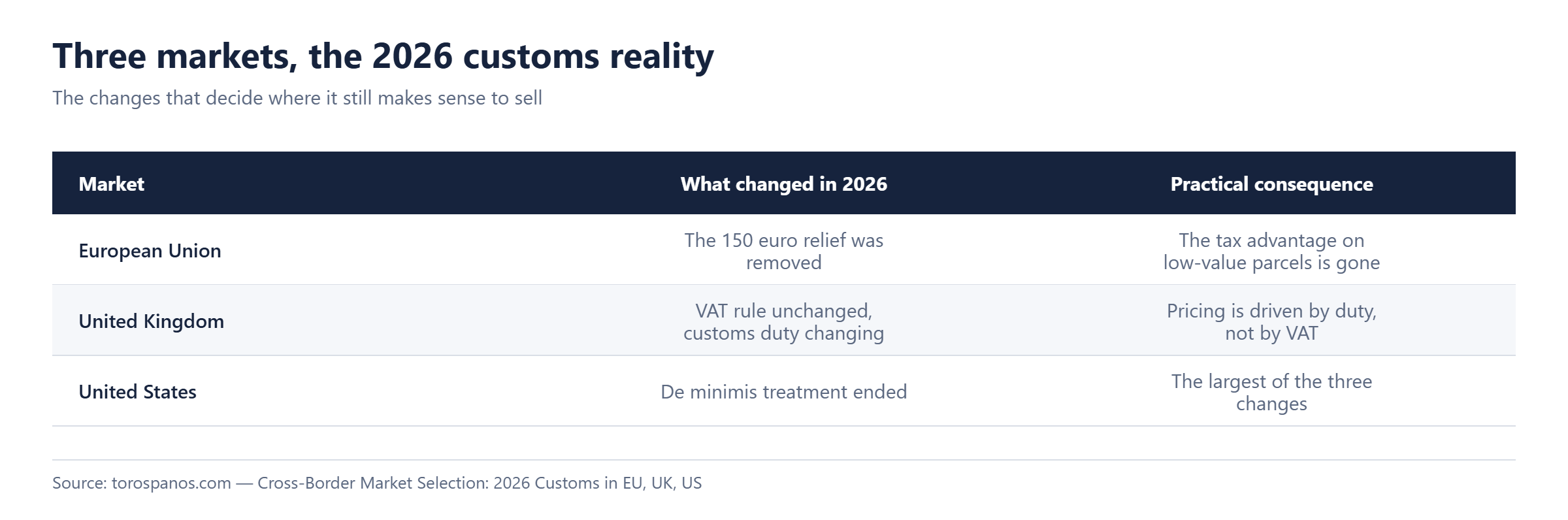
| Market | What changed in 2026 | Practical consequence |
|---|---|---|
| European Union | The 150 euro relief was removed | The tax advantage on low-value parcels is gone |
| United Kingdom | VAT rule unchanged, customs duty changing | Pricing is driven by duty, not by VAT |
| United States | De minimis treatment ended | The largest of the three changes |
European Union: the 150-euro exemption is gone
This is no longer a proposal or a draft; it is a regulation in force. Council Regulation (EU) 2026/382 was published in the Official Journal on 18 February 2026 and applies from 1 July 2026. The regulation repeals Articles 23 and 24 of Regulation 1186/2009; that is, the customs duty exemption on consignments under 150 euros.
A transitional regime replaces it: on distance sales of consignments with an intrinsic value not exceeding 150 euros, 3 euros of customs duty per declaration line. Duration: 1 July 2026 to 1 July 2028.
Two details make the cost larger than you would assume.
“Per declaration line” does not mean per parcel. By the definition in the Commission’s guidance, a declaration line is one or more goods within a consignment sharing the same tariff classification, description and, where applicable, origin. And the 3 euros applies to every line regardless of the amount. So a single parcel containing goods under three different HS codes pays 9 euros. For a store selling multi-item baskets, that affects unit cost far more than single-item sales.
It applies independently of the VAT regime. The Commission guidance is explicit: the 3-euro customs duty is intended to apply to all goods in consignments up to 150 euros in distance sales, irrespective of the VAT regime used (IOSS, Special Arrangements or standard VAT). Being registered for IOSS does not exempt you from this duty.
The 150-euro threshold on the VAT side, by contrast, stays in place. In the words of the same guidance, repealing Articles 23 and 24 will not affect the VAT regimes and rules relating to distance sales. So IOSS is still the mechanism for distance sales under 150 euros; the only thing that changed is that duty in that band is no longer zero.
Turkey and the customs union: a careful sentence
Here I am not going to make the leap most Turkish sources make. The common headline is “Turkish sellers will not pay the 3 euros.” Writing that sentence as it stands is not accurate, because the two pieces of official information we have do not quite complete each other.
What is confirmed: the Commission’s guidance on the 3 euros says that goods benefiting from preferential trade and customs union agreements have to be declared on an H1 declaration where a preference code other than “5” can be given, and that a reduced rate can be claimed. So legally there is a route out. And the Turkish side built the infrastructure to make that route usable: on 3 July 2026 the Ministry of Trade activated the automatic e-A.TR mechanism for simplified-declaration consignments under 150 euros going to the EU, stating the rationale explicitly as “preventing additional financial burdens”.
What is not confirmed: the same Commission guidance also says the 3 euros applies per declaration line without exception on distance sales under 150 euros within IOSS, and a preference claim goes through an H1 declaration, not the low-value data set (H7) that IOSS parcels typically use.
So the correct framing is this: on the Turkish side a mechanism exists for claiming the customs union preference; whether it removes the 3 euros entirely on your consignment depends on which declaration type your carrier uses. Ask your courier that concretely: “Which declaration type do you use on my EU consignments, and do you claim the preference with automatic e-A.TR?” If the answer is “H7”, you are paying the 3 euros and you need to reflect it in your price.
Pending: a per-parcel handling fee
Another charge is on the way in the EU but has not been adopted yet. In the European Commission’s own words: under the Council mandate, the handling fee is expected to enter into force in November 2026; the content and the date are currently under negotiation.
The press widely reports roughly 2 euros per parcel from 1 November 2026. But that amount and date do not yet rest on an adopted legal text. Modelling it as a risk item while pricing 2027 is right; writing it in as a definite cost is not. This is the one EU heading to watch over the next three months.
The long view: EU Customs Reform
The planned structure: the EU Customs Data Hub opens for e-commerce consignments in 2028, becomes voluntary for other importers in 2031 and mandatory in 2034. An EU Customs Authority is being established, duty categories for low-value goods are being reduced to four, and online platforms move into the position of importer responsible for collecting duty and VAT at the moment of purchase.
That last item is the most decisive in the long run: if you sell through a platform, most of the customs liability shifts structurally to the platform. If you sell to the EU from your own site, it does not. That distinction will shape channel strategy after 2028.
United Kingdom: the VAT rule is unchanged, the duty rule is changing
The 135-pound VAT threshold stays in place in the UK. Under HMRC guidance, on consignments not exceeding 135 pounds the overseas seller charges and accounts for UK VAT at the point of sale; on a B2B sale, if the customer provides a UK VAT number, the reverse charge applies. Above 135 pounds, normal import VAT and customs rules operate. There is also a separate 39-pound relief for non-commercial consignments.
The part that is changing is on the customs duty side. The GOV.UK policy paper of 13 July 2026, “Reforming customs rules for low value imports”, announces that the 135-pound customs duty relief on low-value imports will be removed and replaced by a new arrangement including data, payment and compliance requirements.
But the date is not set. The policy paper itself contains no implementation date. Secondary sources point to 2028 or 2029. The correct reading: announced, with the date not yet in the document. If you sell to the UK, this is not a cost item for 2026–2027; it is a monitoring item for 2028 planning.
A critical distinction: VAT and customs duty are two separate rails. The UK removing the duty relief does not change your obligation to collect VAT at the point of sale. That obligation has existed since 2021 and requires VAT registration before your first sale to the UK.
United States: de minimis is over, and this is the biggest change
The 800-dollar exemption (Section 321) no longer exists. The process was completed in three steps:
- Executive Order 14324 (30 July 2025): duty-free de minimis treatment was first suspended for all countries.
- Executive Order 14388 (20 February 2026, effective 24 February 2026): continued the suspension that began with 14324 (its title is “Continuing the Suspension of Duty-Free De Minimis Treatment for All Countries”). The operative provision: no shipment of goods outside the scope of 50 U.S.C. 1702(b) shall receive duty-free de minimis treatment, regardless of value.
- CBP interim final rule (Federal Register, published and effective 24 June 2026; the comment period closed on 24 July 2026): de minimis was suspended indefinitely for goods valued at 800 dollars or less arriving through all modes other than the international postal network, meaning express courier, air and ocean cargo. These shipments must now use formal or informal entry.
- Goods arriving by post are outside the scope of that rule. The postal channel runs a separate “postal informal entry” process for goods valued up to 2,500 dollars; if you ship by post, follow the current CBP CSMS notices.
The operational requirements of the new process make sending individual parcels from Turkey close to impossible:
- A 10-digit HTSUS classification is mandatory on every consignment
- A basic importation and entry bond is required (19 CFR 113.62)
- Duty data must reach CBP by the 7th of the month following arrival
- Payment through Pay.gov
- Goods subject to quota, anti-dumping/countervailing duties or a free trade agreement claim must use formal entry
- Compliance date for the new data fields: 22 October 2026
One temporary layer has also come off: the flat 10% import surcharge imposed in February 2026 under Section 122 of the Trade Act 1974 expired on 24 July 2026 (the 150-day statutory maximum). So duties now consist of the normal MFN rate plus any Section 232 / Section 301 layers.
I am not giving a Turkey-specific rate, and the reason matters: the US tariff architecture has changed three times in the last twelve months (IEEPA tariffs → struck down in court → Section 122 → expired → the Section 301 forced labour list). Whatever rate I wrote would have a high chance of being wrong within three months. The right question: get the current rate on your product’s 10-digit HTS line from your carrier or customs broker.
Practical ways to sell to the US
Three realistic models remain in this picture:
- DDP shipping through a carrier that files the declaration on your behalf. The cost rises but the process stays manageable, and the customer does not get a surprise invoice at the door — which directly affects your return rate.
- Selling through a marketplace in a model where the platform is the importer of record. Most of the compliance burden moves to the platform.
- Storing inside the US (FBA or a 3PL). One bulk shipment, then domestic delivery. In the post-de-minimis world this becomes the most efficient model as scale grows.
The self-managed model of posting parcels under 800 dollars no longer works — it is not possible without a filer and a bond.
Market selection criteria: the 2026 edition
In this picture, market selection has to be done in the following order.
- What is your basket value? In the EU, baskets under 150 euros now carry 3 euros per declaration line. If your average basket is 25 euros, that is a serious line in your unit economics. If your average basket is 200 euros you are outside the 150-euro band and subject to normal import rules. The low-basket, multi-item sales model is the one most affected in the EU.
- How many different HS codes do you sell? A store selling a single-item, single-tariff product pays once per line in the EU. A store selling mixed baskets pays for every line. Your basket consolidation policy is now a customs decision.
- Can you actually use the customs union advantage? If you sell Turkish-origin products and your carrier claims the preference with automatic e-A.TR, you have a structural advantage in the EU. If you sell third-country-origin products, you do not. That makes product sourcing inseparable from market selection.
- Do you have a filer and bond arrangement in the US? If not, think about the US through a marketplace or FBA rather than your own site.
- Do you have a UK VAT registration? It is mandatory on sales under 135 pounds and independent of the change on the customs side.
- Have you costed the product safety and compliance burden? In the EU, GPSR requires an EU-established Responsible Person (in force since 13 December 2024), and because Turkey is not an EU member this requirement cannot be skipped. There are packaging EPR and category-based EPR obligations as well. These are not a per-consignment cost but a fixed entry price — and on low-volume sales into a single country that price cannot be amortised.
For most small sellers those six questions add up to the same conclusion: entering one market with proper compliance is far more profitable than entering three markets with half-compliance. Fixed compliance costs are paid per market; volume gets divided per market.
Setting the expectation correctly
The story of 2026 is this: all three of the world’s major consumer markets have removed, or are removing, the privilege they applied to low-value cross-border consignments. This is a structural change of direction, not a temporary fluctuation. The thing that made cross-border e-commerce easy for a decade — a low-value parcel passing through customs almost invisibly — is ending.
The loser is the model of posting individual small parcels. The winners are the two ends: sellers with a high enough basket value to operate under normal import rules, and sellers who store in the destination market and ship domestically. The model in between — low basket, shipped directly from Turkey — is under cost pressure in all three markets.
One final note: every figure in this post is tied to a date. The EU handling fee may arrive in November 2026, the UK date may be set, the US tariff architecture may change again. If you are a business that updates its price list once a year, that frequency is not enough for 2026–2027. Set up a quarterly review calendar — and write down which source you will check, because secondary sources in this area are systematically late and frequently wrong.
Related reading
- The declaration, VAT refund and support mechanism on the Turkish side: the micro-export and ETGB guide.
- Moving to a storage-in-market model: Amazon FBA or FBM? and Amazon FBA cost layers.
- Writing the new cost items into your unit economics: calculating real profit margin.
Sources: Council Regulation (EU) 2026/382 (OJ 18 February 2026), European Commission guidance on the “3 euro transitional customs duty” (2 June 2026), the EU Customs Reform page, GOV.UK “VAT and overseas goods sold directly to customers in the UK” and “Reforming customs rules for low value imports” (13 July 2026), Executive Orders 14324 (30 July 2025) and 14388 (20 February 2026), the CBP interim final rule (Federal Register, 24 June 2026) and the CBP CSMS notice (8 July 2026), and Turkish Ministry of Trade announcements (3 July and 5 August 2026). All as of August 2026. This post is for information only; it is not customs or tax advice.
Sources and official links
- European Commission — EU Customs Reform — Removal of the EUR 150 exemption and the temporary per-item customs duty
- GOV.UK — VAT on overseas goods sold directly to UK customers — The GBP 135 threshold and VAT charged at the point of sale
- US Federal Register / CBP — Indefinite suspension of the de minimis exemption — The official rule indefinitely suspending the de minimis exemption
- Ministry of Trade — Electronic A.TR movement certificate under simplified declaration — The electronic A.TR movement certificate for exports to the EU
- Ministry of Trade — E-export guides and country customs handbook — Guide to e-export markets and country customs practices
- Ministry of Trade — E-export support programmes — Market-entry and e-export support items
Rules, fee schedules and platform policies change. The figures in this post reflect the position at the time of writing; confirm the current position from the official sources above before you act.
Correction (23 September 2026): the effective date (24 June 2026) and scope (all modes other than the international postal network) of the CBP rule in the US section have been corrected, and the EO 14324 context has been added.
Haftalık bülten
Pazaryeri ve e-ihracatta bu hafta ne değişti?
Komisyon oranları, mevzuat ve algoritma değişikliklerini haftada bir, tek e-postada özetliyorum. Reklam yok, tekrar yok — istediğiniz an tek tıkla çıkabilirsiniz.
